Planning a trip to Spiti Valley in July 2026? It's one of the best times to visit, with both the Manali–Kaza and Shimla–Kaza routes fully open, comfortable daytime temperatures, lush green meadows, blooming wildflowers, and all tourist facilities operating smoothly. This guide covers the expected Spiti Valley opening dates, July road conditions, permit requirements, weather, suggested 7–9 day itinerary, accommodation tips, and essential travel advice to help you experience the valley at its most accessible, scenic, and rewarding.
There's something about Spiti Valley that gets under your skin.
Long drives through landscapes that change character every hour. Monasteries where monks have been doing the same things for centuries. High-altitude villages where life happens at a pace that makes you reconsider your own. Mountains that don't care about your schedule.
July is when most travellers finally make it here. And honestly? There's a reason for that.
By July, both major routes are fully open. Roads are as reliable as mountain roads get. The valley is alive with visitors, local businesses are running properly, and the entire tourist infrastructure is functioning at its best. If you've been putting Spiti off, July is when it stops being complicated and starts being doable.If you're planning your first trip, don't miss our complete guide to Spiti Valley, covering everything from attractions and routes to travel tips and local experiences.
If you're working out the Spiti Valley best time to visit 2026, this guide explains what July actually looks like on the ground, how Spiti Valley road conditions behave through the season, what's involved with a Spiti Valley permit, and how to build a Spiti Valley itinerary that makes the most of a July visit.
Why Does the Spiti Valley Opening Date Matter for July Planning?
Spiti doesn't officially open on a fixed calendar date.
Accessibility depends on snowfall, road-clearing operations, and what the previous winter decided to do. Two main routes go in:
Shimla to Kaza - remains accessible for much of the year. More gradual altitude gain, longer drive, generally more forgiving conditions.
Manali to Kaza - depends on the reopening of high mountain passes, particularly Kunzum Pass. The dramatic route. Also the more adventurous one.
By July, both routes are typically fully open. This is actually one of July's strongest advantages - you're not waiting for passes to clear or hoping road conditions cooperate. The Spiti Valley opening date through Manali usually falls between late May and mid-June, meaning July travellers arrive with the infrastructure already sorted.
No uncertainty. No route anxiety. Just drive.
What Are the Expected Spiti Valley Road Conditions in July 2026?
July is when Spiti Valley road conditions are at their most reliable for most travellers.
Both major routes are fully operational. Road clearance is complete. Local road maintenance crews have had weeks to address the worst of the post-winter damage.
Shimla to Kaza
Smoother, more gradual. Stays accessible and well-maintained through July. Longer driving distances but consistent conditions make planning easier. Ideal for first-timers because the altitude increase is gradual enough to reduce Acute Mountain Sickness risk.
Manali to Kaza
Fully open by July. High mountain passes, spectacular scenery, some rough sections and gravel roads that require patience - but this is Spiti, and that's part of the experience. Water crossings are manageable with early morning starts before glacial melt increases afternoon flow.
The key thing about Spiti Valley road conditions in July: they're about as predictable as mountain roads get. Which isn't perfectly predictable - rockfalls happen, weather changes - but July gives you the best baseline to work from.
Always check current conditions before departure. The mountains don't care about your booking confirmation.
Is July the Spiti Valley Best Time to Visit 2026?
For many travellers, genuinely yes.
July is peak season in Spiti for good reasons.
Fully open roads. Both the Shimla and Manali routes are operational. No route anxiety. No checking whether Kunzum Pass cleared yet. You plan, you go.
Comfortable temperatures. Daytime temperatures in Kaza hover around 18°C to 22°C. Warm enough to actually enjoy being outside for extended periods. Mornings and evenings still cool, which is refreshing rather than punishing.
All businesses running. Cafés, guesthouses, homestays, guides, local tour operators - everything is fully operational. No arriving somewhere to find it hasn't quite opened for the season yet.
Green valleys. July brings a particular version of Spiti that other months don't have. The high-altitude meadows are properly green. Wildflowers are out. The valley looks alive in ways that the brown and white palette of earlier months doesn't capture.
Long daylight hours. More daylight means more driving time, more sightseeing time, more time sitting at a viewpoint watching the light change across the mountains without rushing back before dark.
For the Spiti Valley best time to visit 2026, July ticks boxes that genuinely matter for first-time visitors especially.Spiti is one of the country's top monsoon-season escapes, but you can also explore other best places to visit in July in India for unforgettable mountain and nature experiences.If you're looking to escape the summer crowds and rising temperatures, discover more quiet corners to visit when India heats up for peaceful Himalayan getaways.
What Does July in Spiti Actually Feel Like?
Busy by Spiti standards. Worth clarifying what that means.
Spiti is remote. It requires effort to reach. The kind of casual tourist who shows up unprepared gets filtered out by the journey itself. The people who make it to Kaza in July are, broadly, people who wanted to be there.
That changes the atmosphere. Popular cafés are lively rather than empty. You'll encounter other travellers on the road. Key Monastery will have visitors other than you. This isn't a problem - it's a mountain destination in peak season, not an overrun beach resort.
The valley itself is large enough that crowds rarely feel overwhelming. You can still find moments of complete solitude. Still spend an hour at a monastery with nobody else around. Still pull over on a mountain road and have the view entirely to yourself.
July in Spiti is full of life. That's not a downside.
What Does Spiti Look Like Month by Month?
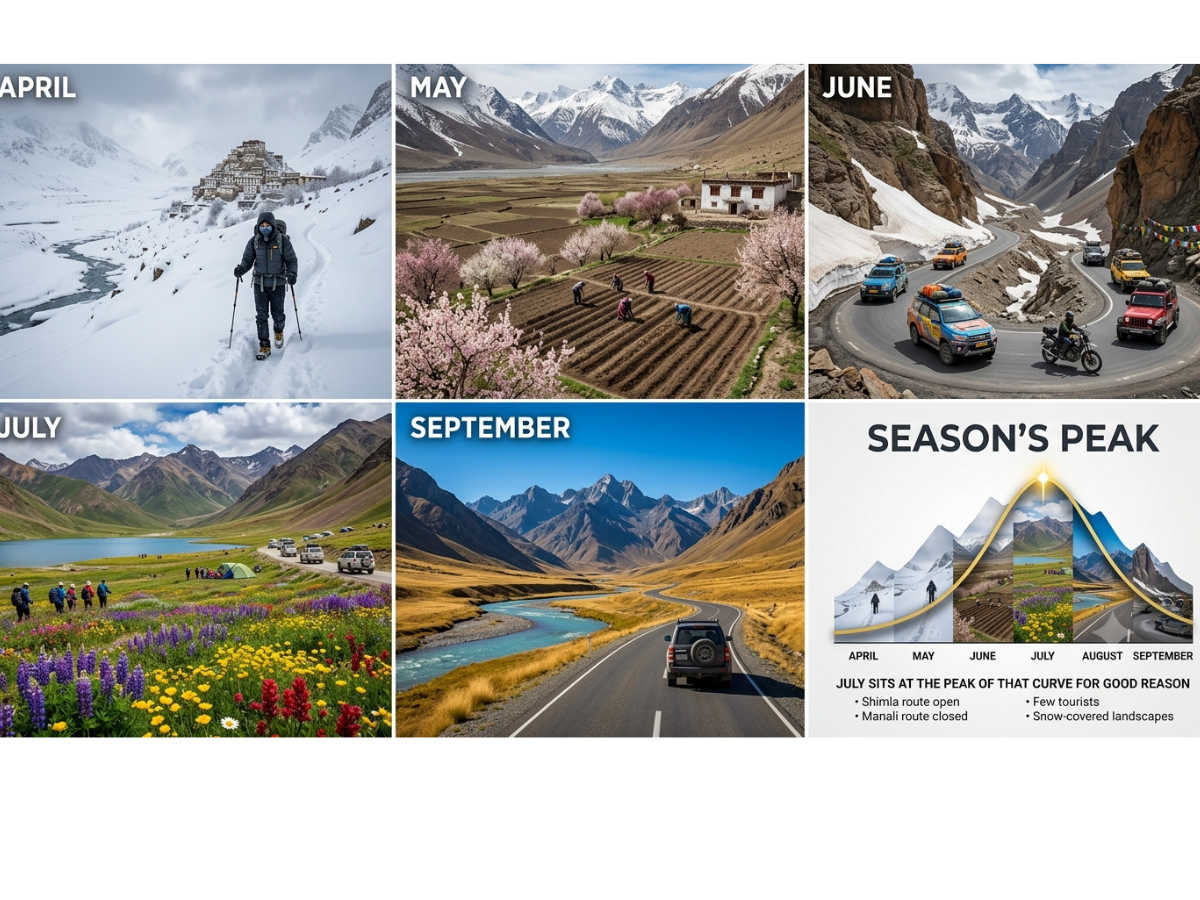
Understanding the full season helps put July in context.
April
Shimla route accessible. Manali route still closed. Very few tourists. Snow-covered landscapes and cold temperatures. Quiet in ways that suit specific types of travellers but require tolerance for limited infrastructure.
May
Valley waking up. Tourist numbers still low. Roads improving. Local businesses beginning to reopen. The Spiti Valley opening date through Manali is approaching.
June
Manali route generally opens. Both routes connect. Snow still visible on peaks. Increasing visitors but not yet peak volume. Good conditions but some infrastructure still finding its feet.
July
Full peak season. Both routes fully operational. All businesses running. Green meadows and wildflowers. Comfortable temperatures. Long daylight. The month when Spiti is most accessible, most alive, and most complete as a travel destination.
September
Post-monsoon clarity. Crystal-clear skies. Fewer visitors than July. Some businesses beginning to wind down. Different light, different atmosphere. Good alternative for those who specifically want quieter roads.
July sits at the peak of that curve for good reason.
What Should a July Spiti Valley Itinerary Look Like?
Seven days works as a solid minimum. Nine days is better. The altitude means rushing is counterproductive - literally, physiologically counterproductive.
Day 1 - Shimla to Kalpa
Gradual start. Let altitude work on you slowly. Kalpa has good views of Kinner Kailash if the evening is clear.
Day 2 - Kalpa to Nako
Nako Lake is worth time. The village feels genuinely old. Easy half-day here before continuing.
Day 3 - Nako to Kaza
Don't skip Tabo Monastery. It's called the Ajanta of the Himalayas and that description holds. Dhankar Monastery en route. Both deserve more than a quick stop.
Day 4 - Kaza Base Day
Key Monastery in the morning - properly impressive and one of Spiti's defining images. Kibber village. Chicham Bridge over a gorge that makes you glad you didn't look down while crossing. Nearby villages for the afternoon.
Day 5 - Langza, Hikkim, Komic
Some of the world's highest inhabited villages. Hikkim post office at 4,400 metres - the world's highest post office, which remains genuinely fun to visit. Langza Buddha statue against mountain backdrop. Komic for sheer altitude achievement.
Day 6 - Chandratal Lake
One of those places where photographs don't prepare you. High-altitude lake with water colour that seems implausible. Worth the effort to get there. In July, conditions are reliable enough to plan this confidently.
Day 7 - Return via Manali
In July, this route is fully open and offers its own spectacular driving experience. Rohtang Pass, Solang Valley, the dramatic descent into the Kullu Valley. The drive back is part of the trip.The Manali–Spiti route is also one of the country's most iconic motorcycle adventures. Discover more of the best bike trips in India for unforgettable rides across diverse landscapes
This Spiti Valley itinerary works with July's conditions rather than around them.
Do You Need a Spiti Valley Permit?
For most Indian travellers visiting the main tourist circuit - no.
A Spiti Valley permit becomes necessary for certain restricted areas near the Indo-Tibetan border. Some specific villages close to international borders require one.
Foreign nationals need to check current regulations more carefully. Rules for border-adjacent areas are more specific and occasionally update.
In July, the permit situation is well-established - local authorities, guesthouses, and guides all know the current requirements. Easier to get clear information in July than during the opening weeks of season when things are still being confirmed.
Sort the Spiti Valley permit question before departure rather than on the road. Minor thing to handle in advance, frustrating thing to discover hasn't been handled when you're already three days in.
What Practical Things Matter for a July Visit?
Acclimatise properly regardless of fitness level. Altitude affects everyone differently. First few days should involve gentle activity rather than aggressive sightseeing. AMS doesn't discriminate.
Book accommodation in advance. July is peak season. The good places - particular homestays, well-rated guesthouses in Kaza and key villages - fill up. Flexibility is nice but having confirmed beds in July is nicer.
Carry substantial cash. ATMs are limited and occasionally not working. Beyond Reckong Peo and Kaza, assume cash is what you have and plan accordingly.
Fuel up consistently. Don't assume the next station is close. It often isn't.
Mobile connectivity is limited but July is peak season - most guesthouses have some wifi, BSNL has the widest mobile coverage, Jio and Airtel work in Kaza and select areas. Download offline maps anyway.
Pack layers despite the warmth. July days are comfortable. July mornings and evenings at 4,000+ metres are not. Temperature drops faster than it does at lower altitudes.
Start driving days early. Afternoon water crossings are higher volume than morning ones because glacial melt increases through the day. This applies in July too.Travelling on a budget? Explore these best budget summer trips under ?15,000 in India for affordable adventures without compromising on memorable experiences.
Why July Is Worth the Visit
Spiti in July is Spiti at its most complete.
Both routes open. All businesses running. Green meadows doing something to the valley that earlier months simply don't show. Long daylight giving you time to actually be in places rather than rushing between them. Comfortable temperatures making the outdoor experience genuinely pleasant rather than something to endure.
The travellers you meet in July are people who made the effort. The infrastructure supports the experience properly. The valley is alive.
For anyone finalising Spiti Valley best time to visit 2026 decisions, July offers something that other months don't - certainty. The Spiti Valley opening date is behind you. Spiti Valley road conditions are at their most reliable. The Spiti Valley itinerary you planned will work the way you planned it.
That's worth something.
Frequently Asked Questions
What are the Spiti Valley road conditions like in July?
July offers the most reliable Spiti Valley road conditions of the season. Both major routes are fully operational. Road clearance is complete. Some rough sections and gravel roads exist on the Manali route but these are expected and manageable. Always check current conditions before departure - mountain roads can change - but July gives you the best baseline.
Is July the best time to visit Spiti Valley in 2026?
For many travellers, particularly first-timers, yes. Both routes open, comfortable temperatures, all infrastructure running, green meadows and wildflowers, long daylight hours. The Spiti Valley best time to visit 2026 question genuinely has July as a strong answer.
What is the Spiti Valley opening date for the Manali route in 2026?
Generally expected between late May and mid-June. By July, both routes are fully open. The Spiti Valley opening date variability doesn't affect July travellers - you're arriving after it's all sorted.
How many days should a July Spiti Valley itinerary cover?
Seven to nine days minimum. The Spiti Valley itinerary needs to account for acclimatisation time, which isn't optional. Rushing altitude is the most common mistake Spiti travellers make.
Do I need a Spiti Valley permit in July?
Most Indian nationals don't need a Spiti Valley permit for the main tourist circuit. Restricted border areas require one. Foreign nationals should verify current regulations before travelling. July is actually a good time to get clear information on this as local authorities and guesthouses are fully operational.
Which route is better for first-timers in July?
Enter via Shimla for gradual altitude gain. Exit via Manali to experience the dramatic mountain passes in full July conditions. Creates a natural circuit and gives you both versions of Spiti's road experience.
Can you visit Chandratal Lake in July?
Yes, reliably. July is actually one of the better months for Chandratal because the Manali-Kaza route is fully open and conditions are stable. Plan it as a proper part of the itinerary rather than a weather-dependent maybe.
How busy is Spiti in July?
Busy by Spiti standards. Not overwhelming by any reasonable measure. The journey filters out casual tourists. You'll encounter fellow travellers, popular spots will have visitors, good guesthouses need advance booking. The valley itself is large enough that solitude remains findable when you want it.
What should you pack for July in Spiti?
Layers regardless of daytime warmth - mornings and evenings are cold at altitude. Sun protection is essential because altitude intensifies UV significantly. Comfortable footwear for both walking and driving days. Cash in substantial amounts. Basic medicines including altitude tablets. Power banks. Offline maps downloaded before entering the valley.
Is mobile connectivity reliable in July?
Limited but predictable. BSNL has widest coverage. Jio and Airtel work around Kaza and select villages. Most guesthouses in July have some wifi connectivity. Download offline maps before arrival, tell people at home communication will be intermittent, and treat connectivity as a bonus rather than an expectation.






 July 6, 2026
 Share
Share
 Download as PDF
  From
From 
 Departure Date
 Travellers & class
 Rent For
 Departure Date







 Share
Share
{{cmnt.comment}}