The question looks simple until the numbers come back. A train ticket is INR 600. An outstation cab is INR 3,500. A self-drive rental is INR 2,200. And then someone points out that the train ticket is per person, the cab is for the full group, and the self-drive does not include fuel. By the time the full cost comparison is done properly, the answer is rarely what the headline fare suggested.
Outstation cab vs self-drive cost comparison is one of those travel planning exercises that most people do approximately rather than precisely, and the gap between an approximate comparison and an accurate one can be several thousand rupees for a weekend trip with three or four passengers. This guide does the comparison properly across different group sizes, journey types, and travel scenarios so the right choice is clear before the booking is confirmed.
Why the Comparison Is More Complex Than It Appears
The core complication in the outstation cab vs self-drive cost comparison is that the costs operate on different models. An outstation cab charges per kilometre plus a driver allowance; the total is a single fare that covers everything, including the driver's time and return journey cost. A self-drive rental charges per day or per kilometre (sometimes both), and the fuel cost on top of the rental rate is the variable that most people underestimate.
A train fare is per person, making it the most group-size dependent of the three; it is cheapest per person but multiplies with headcount, while the cab and self-drive costs are largely fixed regardless of how many passengers occupy the vehicle.
The accurate comparison requires knowing the specific route distance, the specific group size, and what is included in each pricing model before any conclusion is valid.
The Per-Kilometre Cost Breakdown
Outstation Cab Pricing
Outstation cab pricing in India typically works on a per-kilometre rate plus a per-day driver allowance. The per-kilometre rate for a standard sedan is approximately INR 11 to INR 14 per km for a one-way trip; round trips are priced on a return kilometre basis, which is different from the one-way fare doubled.
For a 300-kilometre one-way journey in a sedan, the approximate outstation cab fare is:
- 300 km × INR 12 = INR 3,600 + driver allowance of INR 300 to INR 400 = approximately INR 3,900 to INR 4,000 total. (depends on several governing factors aswell)
- For a larger SUV, the per-kilometre rate increases to INR 14 to INR 18 (depends on several external factors aswell), placing the same 300-kilometre journey at INR 4,500 to INR 5,800.
These fares cover the driver, the vehicle, and the fuel: no additional cost for the passenger beyond the fare itself.
Outstation cab fare calculator tools on booking platforms allow this to be computed accurately for specific routes before the booking is confirmed, which removes the ambiguity of quoted ranges.
Self-Drive Car Rental Pricing
Self-drive car rental pricing involves a daily rental rate plus fuel. The daily rate for a compact hatchback is approximately INR 1,200 to INR 1,800 per day; a sedan runs INR 1,800 to INR 2,500; an SUV is INR 2,500 to INR 4,000 per day depending on the operator and city.
For a 300-kilometre one-way journey in a sedan with one day's rental:
- Rental: INR 2,000
- Fuel(300 km at 15 km/litre, petrol at INR 100/litre): 300/15 × 100 = INR 2,000
- Tolls: (route-dependent, estimate INR 300 to INR 600)
- Total: INR 4,300 to INR 4,600
For a round trip on the same route (600 km total):
- Rental: INR 2,000 (if within a single day) or INR 4,000 (if two days)
- Fuel: INR 4,000
- Tolls: INR 600 to INR 1,200 (route-dependent)
- Total: INR 6,600 to INR 9,200
The self-drive car rental vs cab comparison for a round trip already shows the self-drive running higher than the outstation cab for solo or two-person travel. The driver cost is replaced by the fuel cost, and the fuel cost often exceeds the driver allowance component of the cab fare.
Train Pricing
Third AC train fare for a 300-kilometre route is approximately INR 700 to INR 900 per person. The sleeper class is INR 250 to INR 400 per person. For a group of four travelling in third AC, it is approx. 4 × INR 800 = INR 3,200 total, and for sleeper class, it is approximately around 4 × INR 350 = INR 1,400 total.
The train has no fuel variable and no driver variable; the fare is the total cost. But it requires the destination to have a station, it operates on a fixed schedule, and it does not provide door-to-door travel, which means local transport at both ends adds to the effective total cost.
The Group Size Variable: Where Each Option Wins
Solo Travel
Solo travel on a long-distance route strongly favours the train. The road trip cost per person for a solo traveller in an outstation cab (INR 3,900 to INR 4,000 for 300 km) or a self-drive (INR 4,300 to INR 4,600) is four to six times the third AC train fare for the same distance. The train is not merely cheaper; it is in a different cost category for solo travel on routes with good rail connectivity.
Self-drive for solo travel adds value only where the destination lacks a railway station or requires access to multiple locations during the trip that would otherwise require local transport at an additional cost.
Two Passengers
The outstation cab vs self-drive cost comparison for two passengers starts to shift. The cab fare (INR 3,900 to INR 4,000 shared between two) becomes INR 1,950 to INR 2,000 per person, comparable to a third AC train fare but with the flexibility of departure timing and door-to-door travel. The self-drive for two is still running higher than the cab on most routes.
Three to Four Passengers
Group travel cost comparison at three or four passengers is where the cab becomes genuinely competitive with the train. The outstation cab fare divided by four passengers is INR 975 to INR 1,000 per person for the same 300-kilometre journey equal to or lower than the Third AC train fare, with the added benefits of flexible departure, direct route, and door-to-door travel.
At four passengers, the outstation cab and the train third AC are approximately equivalent on per-person cost for most routes. The train retains the advantage for longer routes where the distance multiplies the comparison significantly and for overnight journeys where the train converts travel time into sleeping time.
Five or Six Passengers
At five or six passengers, an outstation cab typically requires an SUV, which shifts the per-kilometre rate upward. A seven-seater SUV at INR 16 per km for 300 kilometres produces a total of INR 4,800 to INR 5,200 divided by six passengers, INR 800 to INR 870 per person. The self-drive SUV rental with fuel for six passengers runs INR 6,000 to INR 8,000 total, or INR 1,000 to INR 1,350 per person.
At this group size, the train remains the most cost-efficient option on a per-person basis for routes with direct rail connectivity. The outstation cab becomes competitive when rail connectivity is indirect or the destination requires ground flexibility.
When to Choose Each Option
Self-drive car rental vs cab is a decision with a specific answer for each trip type:
- Choose the outstation cab when the group has three or four passengers, the journey is under 400 kilometres, the departure time flexibility is important, the return timing is uncertain (one-way cabs avoid paying for an empty return), and the destination has limited local transport.
- Choose the self-drive when the trip spans multiple days and multiple local destinations (the daily rental covers a full day's movement rather than a fixed route), the travellers are comfortable driving in unfamiliar terrain, and the per-day cost, including fuel, works out lower than an equivalent multi-stop cab itinerary.
- Choose the train when travelling solo or as a couple, the journey exceeds 400 kilometres, the destination has a railway station within reasonable distance of the final destination, overnight travel is possible (converting travel time to sleep time), and the departure and arrival times are fixed.
How EaseMyTrip Brings All Three Options Together
The outstation cab vs self-drive cost comparison accuracy depends on having the correct fare data for all three transport modes alongside each other rather than in separate searches. EaseMyTrip's multi-modal platform surfaces outstation cab fares, including the per-kilometre rate and driver allowance for the specific route, alongside train availability and self-drive rental options in a single planning interface.
The platform's outstation cab fare calculator tool computes the full route cost, including tolls and driver allowance for a searched destination, making the comparison with train fares and self-drive rental costs immediate rather than requiring separate calculations. For group travel cost comparison across different passenger counts, a family of four versus a couple versus a solo traveller on the same route, the per-person cost breakdown adjusts automatically as the group size is entered.
As AI continues to improve how booking platforms surface personalised transport comparisons accounting for the specific route, the group size, the travel date, and the available inventory across all modes EaseMyTrip is building towards a platform that presents the road trip cost per person comparison as a decision-support tool rather than a raw data presentation. For travellers who want to know which option is actually cheaper for their specific trip rather than which is cheapest in the abstract, that kind of specific, group-size-aware, route-accurate comparison is what makes the booking decision genuinely informed.
FAQs
Q: How does the outstation cab vs self-drive cost comparison work for a group of four?
The outstation cab vs self-drive cost comparison for a group of four on a 300-kilometre route typically favours the outstation cab. The cab fare of INR 3,900 to INR 4,000 divided by four passengers gives INR 975 to INR 1,000 per person. The self-drive sedan with fuel and tolls on the same route runs INR 4,300 to INR 4,600 total, INR 1,075 to INR 1,150 per person before accounting for the return journey cost. The outstation cab includes the driver, covers the return distance in the fare, and requires no fuel management from the travellers.
Q: When is self-drive car rental cheaper than an outstation cab?
Self-drive car rental vs cab favours the self-drive in specific scenarios: multi-day trips where the vehicle is used for local movement at the destination across multiple days, reducing the per-day cost relative to hiring a cab for each local journey; routes where the destination has multiple stops that would require a full-day cab hire at the destination city rate; and weekend trips where the per-day rental rate is low and the fuel cost is manageable. For straightforward point-to-point journeys with a return on the same day or the following day, the cab generally works out comparable to or cheaper than self-drive for groups of three or more.
Q: What does an outstation cab fare calculator show, and how accurate is it?
An outstation cab fare calculator on a booking platform computes the total fare for a specific route based on the per-kilometre rate for the vehicle category, the route distance, the driver allowance, and applicable tolls. The calculation is accurate for the rates the specific operator is quoting at the time of the search. Variables that may add to the final fare include waiting time if the journey involves stops, hill station or restricted area charges, and night driving allowances for journeys that extend past 10pm. Reading the fare breakdown rather than just the headline total confirms what is included.
Q: How does the group travel cost comparison change between two and six passengers?
Group travel cost comparisons shift significantly with group size. At two passengers, the train Third AC is typically the cheapest per-person option on most routes over 200 kilometres. At three passengers, the outstation cab per-person cost approaches the train fare. At four passengers, the outstation cab and train third AC are broadly equivalent per person, with the cab offering flexibility advantages. At five or six passengers, an SUV cab is required, and the per-person cost rises slightly, but the train remains cheaper per person on longer routes where the per-kilometre multiplier is larger.
Q: How can EaseMyTrip help compare outstation cab, self-drive, and train costs?
EaseMyTrip’s multi-modal platform displays outstation cab fares, train availability across all classes and self-drive rental options for a searched route in one interface. The outstation cab fare calculator calculates the entire trip cost, including driver allowance and tolls. The cost per person is adjusted as per the number of people in the group entered. AI-powered comparison tools line up the cost per person of the road trip for each mode of transport and reveal the most cost-effective option for that trip before you decide to book rather than after.






 October 8, 2026
 Share
Share
 Download as PDF
  From
From 
 Departure Date
 Travellers & class
 Rent For
 Departure Date







 Share
Share 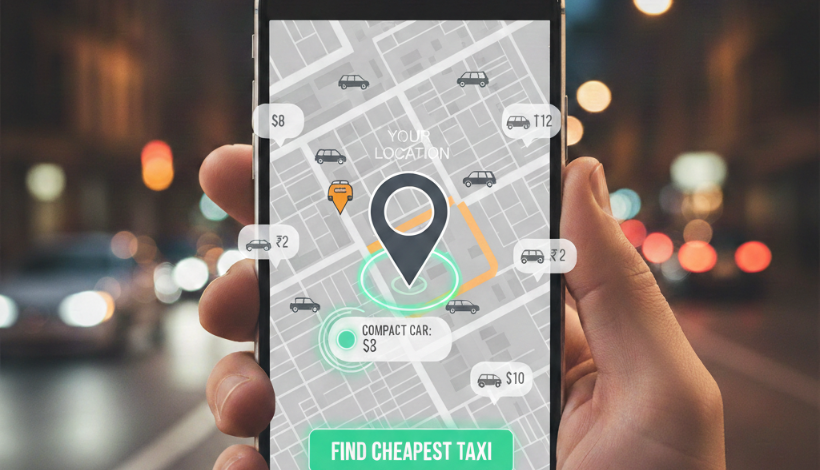





{{cmnt.comment}}