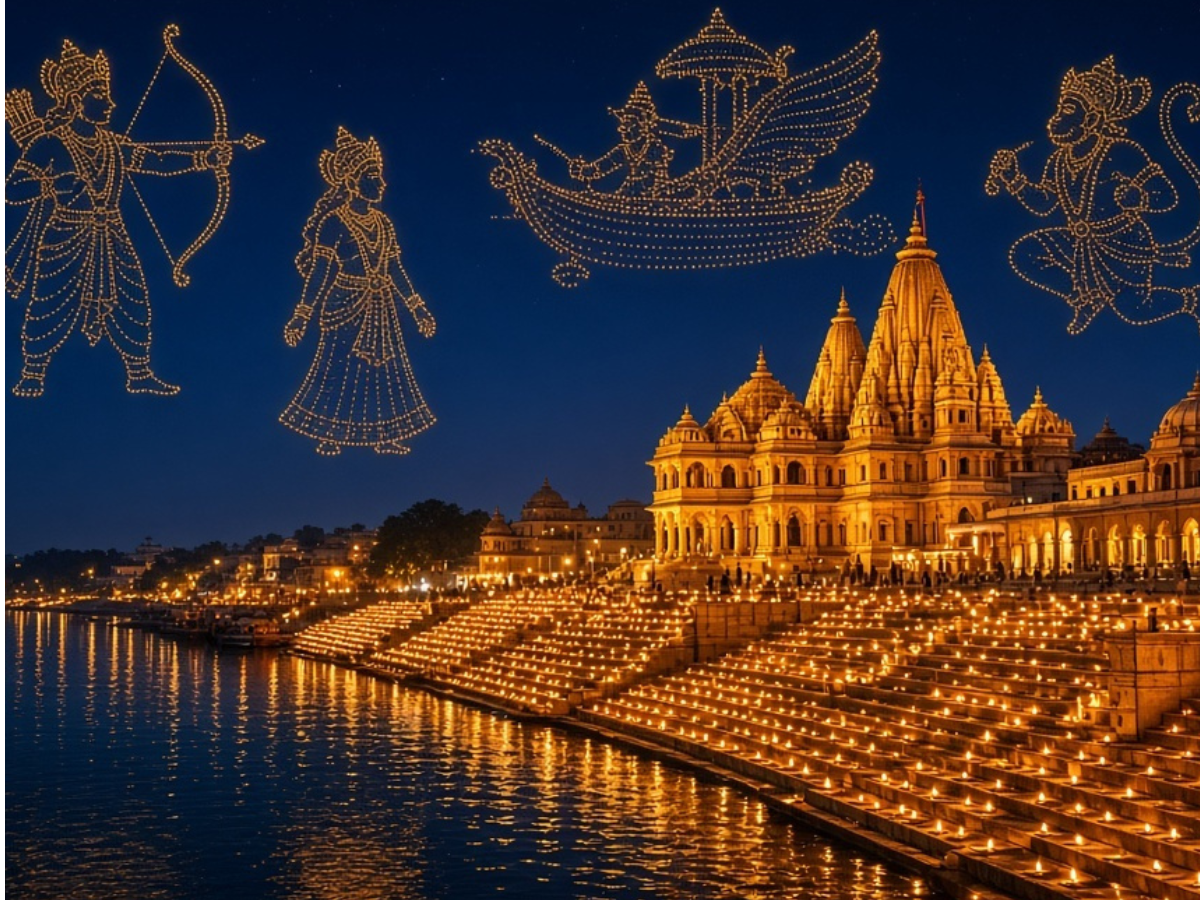
Picture a riverbank where millions of earthen lamps are lit in a couple of hours, a temple glowing in the distance and drones tracing the Ramayana across the night sky. That is Diwali in Ayodhya, and this year the city marks its 10th Deepotsav. Expect long queues, the smell of ghee lamps and a crowd that has come to pray as much as to watch. This guide covers the dates, the celebrations, the best viewing places, how to reach Ayodhya, where to stay, a two-day plan and practical tips for handling the rush.
Ayodhya Diwali: Why It Is Special
Most cities celebrate Diwali. Ayodhya is where the story happened. This is Ram's birthplace, the Ram Janmabhoomi, and the Ram Mandir now stands at the centre of the town. According to the tradition, Ram returned here after fourteen years of exile and the city lit lamps to welcome him. Every Diwali, Ayodhya repeats that welcome.
The mood of Ayodhya Diwali is different from a metro-city celebration. The ghats glow, temples stay open late, the lanes fill with pilgrims, and the whole town runs on devotion and adrenaline at the same time. It is busy, loud and moving, often all in the same hour.
When Is Diwali Celebrated in Ayodhya
In 2026, Diwali falls on Sunday, 8 November. The Ayodhya Deepotsav is scheduled for Saturday, 7 November, the eve of Diwali, as confirmed in the Uttar Pradesh government's preparation review on 23 October.
In practice, the celebration runs over two days. Deepotsav takes over the city on the 7th, and Diwali night on the 8th is quieter and more personal, with decorated temples, lamps on every doorstep and family pujas. If you want both, plan to be in town from 6 November.
On Deepotsav day, the order is set: a procession first, then the programmes at Ram Katha Park, and the Saryu Aarti and mass diya lighting at dusk. Sunset in early November is a little after 5 PM, so plan to be at the riverfront well before that. The state tourism department announces the exact hour-by-hour schedule a few days before the event.
Ayodhya Deepotsav: What to Expect
The Ayodhya Deepotsav is a state-organised festival of lights held on the eve of Diwali. The UP government started it in 2017, and the 2026 edition is the tenth. It is not an ordinary Diwali evening. The whole riverfront is arranged for it, with ghats set out in grids of lamps, a stage programme, crowd management and a night show.
Diya Count and World Record
The current record stands at 26,17,215 diyas lit across 56 ghats in 2025, verified by Guinness World Records through drone counting. The same evening also set a record for the most people performing aarti together, with 2,128 participants on the Saryu bank.
The 2026 figure is confirmed by officials after the lighting. Ahead of the event, a state tourism department review mentioned a target of around 30 lakh diyas, and the Chief Minister has asked for millions of lamps across Ayodhya, including Ram Ki Paidi.
Laser Show, Ramlila and Cultural Programmes
According to the official preparation plan, the 2026 festival runs in three phases:
- Procession: A tableau procession starts from Saket Mahavidyalaya, showing episodes from the Ramayana through performance.
- Ram Katha Park: The ceremonial arrival of artists playing Ram and Sita, Bharat Milap and the coronation of Ram.
- Evening at Ram Ki Paidi: Saryu Aarti with 2,147 participants, diya lighting, performances by around 200 artists, a Ramayana-themed show with 2,100 drones, a laser presentation, green fireworks near Gonda Bridge and Ramlila performances by international troupes.
About 35,000 volunteers and roughly 1,000 artists from different states are expected, with cultural representatives from 12 countries. The tourism department also plans a static Pushpak Viman installation in the Saryu. The 2,100-drone show is expected to be repeated at Jamghat, two days after Deepotsav, for those who miss the first night. Segment timings are shared by the state tourism department shortly before the event, but the evening show at Ram Ki Paidi always follows the aarti and diya lighting, so arriving by late afternoon covers everything.
Diwali Celebration in Ayodhya: How It Is Celebrated
The Diwali celebration in Ayodhya is not limited to one stage. The ghats get the big public display, while temples and homes carry their own version. Lamps line the temple steps and lanes, doorways get fresh rangoli, and shops and homes are strung with lights and marigold. Most families do Lakshmi-Ganesh puja at home on Diwali night and then step out to see the town lit up.
Saryu Aarti and Puja Rituals
The Saryu Aarti is held at dusk on the riverbank. Priests lead the chanting, lamps are raised in unison, and devotees float small diyas on the water. During Deepotsav, the aarti is a large, organised event, and the 2026 plan includes 2,147 participants. If you want a calmer version, the regular evening aarti on a normal day is smaller but just as moving.
Local Traditions, Sweets and Food
Milk sweets such as pedas and laddoos are the standard prasad and gift. For breakfast near the temples, the usual choice is hot kachori-sabzi with jalebi, which suits an early darshan morning. Most food stalls and sweet shops stay open late during the festival, and prices near the main venues tend to be higher than in the old town lanes.
Best Places to Watch Diwali in Ayodhya
Ram Ki Paidi
What's special: This is the main Ram Ki Paidi Deepotsav venue, where the ghats are filled with lamps and the evening programme takes place.
Best time: Reach by mid-afternoon. Entry to some areas is controlled and fills early.
Tip: Pick your exit route before the show begins. Leaving after the drone show is the slowest part of the night.
Saryu Ghat
What's special: The aarti, the floating diyas and a long view along the river.
Best time: About an hour before sunset.
Tip: The steps near the water get crowded first. A spot slightly higher up gives a better view and an easier exit.
Ram Mandir
What's special: Diwali at Ram Mandir means decorated approaches and a steady stream of devotees.
Best time: The temple's free darshan runs in slots from 7 AM to 9 PM, with a gap between 12 and 1 PM. The first slot of the day usually has the shortest wait.
Tip: The temple Trust issues darshan and aarti passes free of charge through its own official portal. Do not pay anyone claiming to sell "VIP darshan".
How to Reach Ayodhya for Diwali
By air: Maharishi Valmiki International Airport serves Ayodhya directly. Lucknow, Gorakhpur and Varanasi airports are the alternatives, each with a road transfer afterwards.
By train: Ayodhya Dham Junction has services from Delhi, Lucknow, Varanasi and Mumbai, among other cities. If you are travelling to Ayodhya for Diwali, book trains and flights as early as you can, since festival-week seats fill up weeks ahead.
By road: Approximate distances are Lucknow about 135 km, Gorakhpur about 130 km, Prayagraj about 165 km and Varanasi about 200 km. Lucknow and Gorakhpur are roughly three hours away on a normal day. On Deepotsav day, add buffer time for checkpoints near the city.
Inside the city: E-rickshaws and walking are the main ways to get around. Expect vehicle restrictions around Ram Path and the main venues during the festival, so plan to walk the last stretch.
Where to Stay in Ayodhya During Diwali
If you are planning to stay in Ayodhya during Diwali, the area around the Ram Mandir and Saryu Ghat is the most convenient but also the most expensive. The Faizabad side has more rooms at lower prices and is a reasonable base if you do not mind a short ride.
Options: Dharamshalas for simple, low-cost stays, budget hotels, mid-range hotels, a few luxury properties and homestays.
Booking: Rooms for festival week sell out well in advance, and rates rise noticeably. If you have not booked yet, do it now. If central Ayodhya is full, Faizabad or even a base in Lucknow with an early start are workable fallbacks.
Distance: Staying a little away from Ram Ki Paidi is calmer, but only if road access is open. On Deepotsav evening, a 2 km distance can take much longer than it looks.
Ayodhya Diwali Trip Plan (1-2 Day Itinerary)
For an Ayodhya 2 day itinerary that covers both the temples and the Deepotsav, this plan works well. If you only have one day, combine Day 1's morning with Day 2's evening.
Day 1: Temples and Saryu Aarti
- Early morning: Ram Mandir darshan in one of the first slots
- Late morning: Hanuman Garhi and Kanak Bhawan
- Afternoon: rest and lunch
- Evening: Saryu Aarti at the ghat
Day 2: Deepotsav Day
- Morning: a light visit to nearby places, or the procession from Saket Mahavidyalaya if you want to see it
- Afternoon: rest, eat early, charge your phone
- Late afternoon: head for Ram Ki Paidi
- Evening: aarti, diya lighting and the night show. Leave a little before the final show ends if you want to avoid the thickest crowd
Here is a rough budget for a two-night trip. These are approximate figures only.
| Item |
Approx. cost |
| Stay (2 nights, per room) |
INR 3,500 to INR 12,500+ |
| Food (per person) |
INR 800 to INR 1,500 |
| Local transport (per person) |
INR 400 to INR 800 |
Travel to and from Ayodhya is extra. Prices are approximate and vary with the season, and hotel rates in particular can rise well above these ranges during the peak Diwali and Deepotsav days.
Tips for Experiencing Diwali in Ayodhya
These Ayodhya Deepotsav tips come down to timing and patience:
- Arrive early: Reach Ayodhya the day before, ideally by 6 November. Roads around the venues can be restricted by the afternoon of the event.
- Entry: General viewing is free. Any official pass details are announced only by the state tourism department or the Ayodhya district administration, so ignore third-party "pass booking" sites.
- What to wear: Modest clothes and comfortable footwear. You will walk a lot, and some temple areas need you to remove shoes.
- What to carry: Water, a power bank, a light jacket for the evening, a government photo ID and any darshan or aarti pass.
- With children or senior citizens: Choose a spot close to an exit, agree on a meeting point and avoid the densest hours around the drone show.
- Photography: The ghats look best in the blue hour just after sunset. Skip flash near the aarti, and keep your phone strapped or in a pouch in dense crowds.
FAQs
Q.1 What is the difference between Deepotsav and Diwali in Ayodhya?
Ans. Diwali is the festival itself, celebrated at homes and temples on the amavasya night. Deepotsav is the large state-organised lamp-lighting event held on the eve, with a procession, aarti, a drone show and cultural programmes.
Q.2 Is Ayodhya Deepotsav free to attend?
Ans. General viewing is free. Some enclosures are controlled by the administration, and any pass details come only from the state tourism department or the district administration. Check them before you travel.
Q.3 Where is the best place to watch Deepotsav?
Ans. Ram Ki Paidi is the main venue and the best place for the full diya display. For the aarti and floating lamps, Saryu Ghat is a good second choice. Go early to either.
Q.4 How many diyas are lit in Ayodhya Deepotsav?
Ans. In 2025, 26,17,215 diyas were lit, a Guinness World Record. For 2026, the pre-event target was around 30 lakh, and the final count is confirmed by officials after the lighting.
Q.5 Are there traffic diversions or restricted zones during Deepotsav?
Ans. Yes, you should expect them. Vehicle restrictions around Ram Path and the main venues are usual, so plan to walk and use e-rickshaws. The administration announces diversions shortly before the event.
Q.6 Is Ayodhya crowded and safe for families during Diwali?
Ans. It is very crowded, but security is a stated priority, and the preparation plan stresses crowd management and devotee convenience. Families should arrive early, stay together and fix a meeting point.
Q.7 What is the weather in Ayodhya during Diwali?
Ans. Pleasant. Early November days are mild, and the nights get cool, so carry a light jacket for the evening programmes.
Conclusion
Diwali in Ayodhya is worth planning for, and the planning is simple: book your stay now, reach town a day early, spend one morning at the temple and one evening on the Saryu ghats. The crowd is big, but a bit of preparation turns it into a calm, memorable trip. If you have ever wanted to see Diwali where the story began, 2026 is a good year to go.





 October 24, 2026

 Share
 Download as PDF
 From

 Departure Date
 Travellers & class

 Rent For
 Departure Date


 Share
{{cmnt.comment}}