The question of which train class to book train ticket is one of those decisions that looks straightforward until the fare comparison comes back and the numbers are further apart than expected. The jump from Sleeper to Third AC can be two to three times the base fare. The jump from Third AC to Second AC adds another meaningful increment. And first AC, at the top of the hierarchy, can cost more than a budget airline fare on the same route.
The AC vs sleeper class train comparison is not a question with a universal answer. It is a context-dependent calculation; the right class for a six-hour daytime journey is not necessarily the right class for a sixteen-hour overnight run, and the right class for a 35-year-old solo traveller may be genuinely different from the right class for a family with elderly members or young children. This guide covers what each class actually provides, where the value sits, and how to make the decision for specific journey types rather than in the abstract.
What Each Class Actually Provides
Sleeper Class (SL)
Sleeper Class is the backbone of Indian Railways' long-distance travel, the most booked class on the network and the class that most of the country travels in. It is a non-air-conditioned berth configuration with six berths per bay (upper, middle, and lower on each side) and two side berths in the corridor sections.
The practical experience of Sleeper Class depends significantly on the route, the train, and the time of year. From October through February, the cool months, an overnight sleeper journey on a well-maintained train is genuinely manageable: a clean berth, open windows if preferred, and adequate space to sleep horizontally. In May and June, the same berth on a daytime crossing of the Rajasthan plains is a fundamentally different experience; the heat through open windows versus the heat of a closed non-AC compartment is the specific trade-off that the class does not resolve.
Sleeper class comfort tips that experienced travellers consistently apply: lower berths are the most comfortable position for most journeys, the side-lower berths in the bay end section offer cross-ventilation that the centre bay does not, and carrying an eye mask and earplugs converts even a moderately noisy Sleeper journey into one that allows real rest.
The key train class price comparison data point for Sleeper: it is the lowest overnight journey fare on the network, and for routes under eight hours and in the cooler months, it often represents genuine value rather than a compromise.
Third AC (3A)
The third AC is air-conditioned with six berths per bay, the same configuration as the sleeper but with AC, closing doors on the bay, bedding provision (sheets, pillow, and blanket in the bedding roll), and a more contained coach environment. The berths themselves are comparable in width and length to Sleeper, and the basic sleeping comfort is not dramatically different.
What AC provides that Sleeper does not is temperature control, which changes the equation completely for summer travel and for routes through high-temperature regions. A third AC overnight in May is a different experience from the same night in Sleeper; the temperature inside the coach is maintained at approximately 22 to 24 degrees, which is comfortable for sleeping, while the Sleeper equivalent can reach 35 degrees or above by midnight on the plains routes.
The ac vs sleeper class train comparison favours Third AC most clearly for summer travel (April to June), routes through high-temperature regions regardless of season, journeys over twelve hours where sustained sleep quality matters, and travellers who find the open-coach environment of Sleeper difficult to manage.
The fare premium for Third AC over Sleeper is typically 2.5 to 3 times the Sleeper fare. On a route where the sleeper fare is ?350, third AC may be ?900 to ?1,100. Whether this premium is worth paying is the calculation the journey length and season most clearly determine.
Second AC (2A)
Second AC is a different experience rather than simply a better version of Third AC. The configuration changes: four berths per bay rather than six, with a full curtain that closes the bay entirely. The increased privacy and the reduced occupancy per bay change the social dynamic of the coach; there are fewer co-passengers in the immediate sleeping space, and the curtain means the berth is genuinely private rather than semi-private.
The 3AC vs 2AC difference is most meaningful for travellers who place high value on privacy, longer journeys of sixteen hours or more where the six-berth bay's social proximity becomes more wearing over time, couples who want to share a bay without six other berths in the same space, and business travellers for whom the sleep quality and privacy affect the productivity of the following day.
The fare premium for Second AC over Third AC is typically 1.5 to 1.8 times the Third AC fare. On the same route where the third AC is ?1,000, the second AC is typically ?1,500 to ?1,800. The privacy gain is real and consistent; whether it justifies the additional cost depends on the individual's travel priorities and the journey length.
First AC (1A)
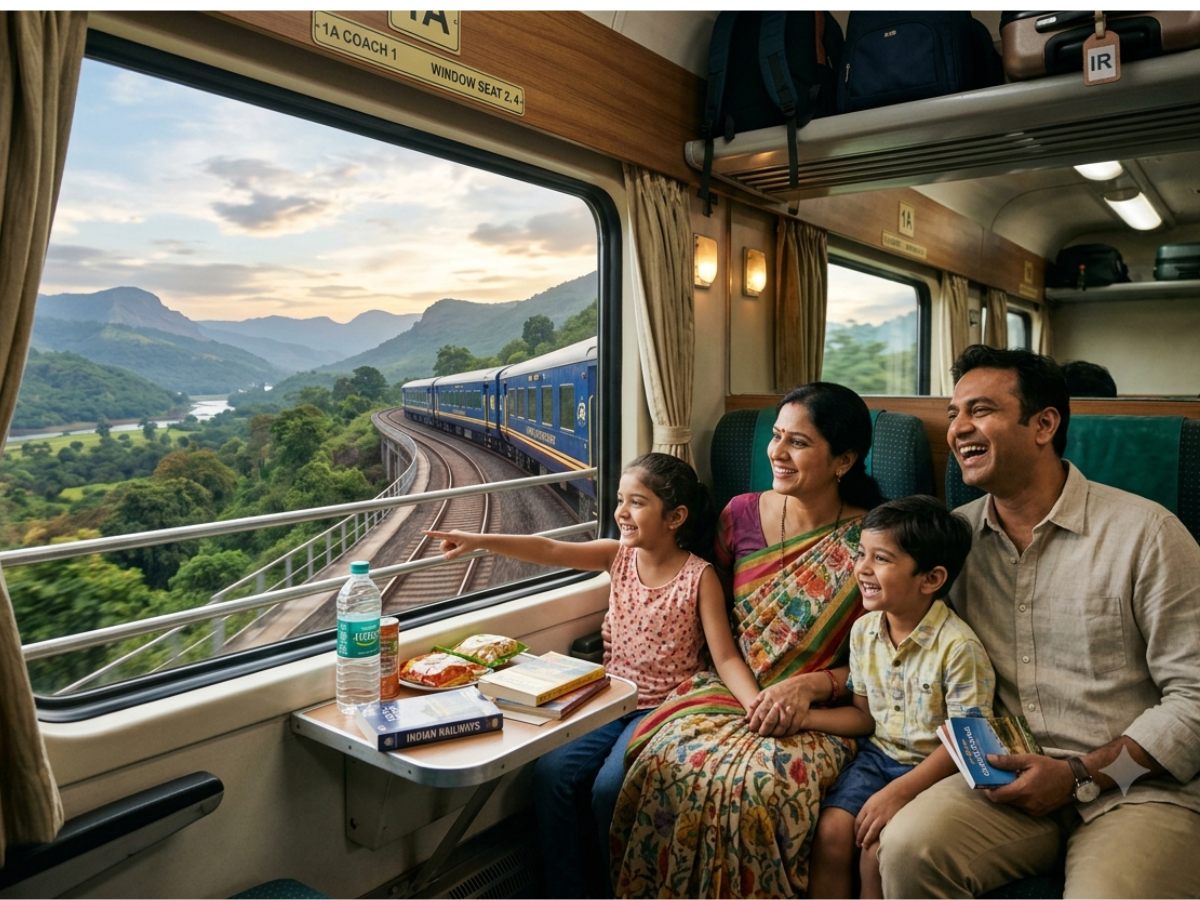
First AC provides enclosed private or semi-private compartments, either two-berth or four-berth cabins, with a lockable door at the top of the pricing hierarchy. The berths are wider than in the second AC, the cabin is enclosed, and the level of privacy is the closest Indian Railways comes to a private sleeping space.
The best train class for a long journey argument for First AC is most compelling on journeys exceeding eighteen to twenty hours, for senior travellers who need the enclosed space for comfort and security, and for business travel where the cabin provides a working and sleeping environment. The fare on First AC is typically 3 to 4 times the Third AC fare and may be comparable to or higher than budget airline fares on the same route, which makes the decision partly about the value of the train journey experience itself versus the flight alternative.
The Train Class Price Comparison: Making the Decision
For Journeys Under Six Hours
Train class price comparison favours Sleeper for short journeys where the berth is not being used for sleep; a daytime crossing of four to five hours does not require air conditioning to be comfortable in the cooler months, and the Sleeper fare on a short route is the most efficient way to travel. The third AC on a four-hour journey is paying for air conditioning across a period where the train's motion alone keeps the coach tolerable in most seasons.
Exception: the summer months of April to June, where even a four-hour crossing of a hot-climate region makes the AC premium worth paying for basic comfort rather than genuine luxury.
For Overnight Journeys of Eight to Fourteen Hours
The AC vs sleeper class train comparison for the classic overnight journey Delhi to Jaipur, Mumbai to Goa, and Bengaluru to Chennai length runs typically resolves in favour of third AC for the majority of travellers who prioritise sleep quality and temperature control over fare minimisation. The bedding provision and the AC environment produce meaningfully better rest across eight to twelve hours than Sleeper, and the fare increment is the most justified it gets anywhere in the class hierarchy for this journey length.
The second AC for this journey length is a personal preference decision rather than a straightforward value call. The privacy benefit is real, but the incremental fare over Third AC is substantial for a journey that most travellers complete in a single sleep cycle.
For Long-Distance Journeys Over Sixteen Hours
The best train class for long journey consideration shifts at the sixteen-hour mark. The cumulative effect of six berths in the same bay over an extended period, the comings and goings at intermediate stations, and the shared space through two full nights or a full day and night makes the second AC privacy premium and more defensible on the longer journeys. First AC becomes relevant for very long journeys (Mumbai to Howrah, Delhi to Trivandrum), where the enclosed cabin is the equivalent of a private hotel room for twenty hours.
Sleeper Class Comfort Tips for Budget Travellers
Sleeper class comfort tips that make a Sleeper journey significantly more manageable:
- Book a lower berth specifically because it is cooler in summer (hot air rises), easier to access at night, and provides a seat during the day that upper-berth passengers cannot use without climbing.
- Carry a small bag for the berth with essentials (accessible phone, charger, water bottle) rather than needing the main bag from the overhead rack at 3am.
- Board knowing which side of the train your berth is on relative to the sun's direction during the midday segment of the journey on a westbound afternoon train, a berth on the western side of the coach will receive direct afternoon sun through the window.
- A battery-operated portable fan (compact models exist specifically for train travel) converts a summer sleeper berth from uncomfortable to manageable at a fraction of the third AC premium.
How EaseMyTrip Supports Train Class Selection
Ac vs sleeper class train comparison decisions require seeing the fare difference and the class specifications side by side rather than making assumptions. EaseMyTrip's train booking platform displays all available classes for a searched route in a single comparison: Sleeper, Third AC, Second AC, and First AC, where available, with fare, availability, and berth count shown together so the value calculation is visible before the decision is made.
The platform's AI-powered recommendation tools surface the best train class for long journey suggestions based on the journey length entered and the travel date flagging, for example, that a summer date on a high-temperature route makes the AC upgrade more valuable than the same route in November. As AI continues to improve how booking platforms personalise class recommendations based on the specific journey parameters departure time, route temperature profile, journey length, group composition EaseMyTrip is building towards a system that makes the train class price comparison a genuinely informed recommendation rather than a presentation of options that the traveller has to evaluate entirely independently. For a decision that has a meaningfully right answer for each specific journey, that kind of contextually intelligent class guidance is what turns a booking platform into a planning tool.
FAQs
Q: What is the main difference in the AC vs sleeper class train comparison?
The core AC vs sleeper class train comparison difference is temperature control and the bedding provision. Sleeper Class is non-air-conditioned with open windows; Third AC is air-conditioned with bedding provided. The physical berth configuration is similar in both six berths per bay, but the thermal environment differs significantly, particularly in summer when sleeper coaches in high-temperature regions can reach 35 degrees or above, while Third AC maintains approximately 22 to 24 degrees. The Sleeper fare is typically one-third of the Third AC fare on the same route.
Q: What is the 3AC vs 2AC difference, and when does the second AC justify the premium?
The 3AC vs 2AC difference is primarily privacy. The third AC has six berths per bay with a partial curtain; the second AC has four berths per bay with a full curtain that closes the bay entirely, providing a genuinely private sleeping space. The second AC premium over the third AC, typically 1.5 to 1.8 times the third AC fare, is most justified on journeys over sixteen hours where the accumulated effect of six-berth proximity becomes more wearing, for couples who want a shared private bay, and for business travellers who need undisturbed sleep to function the following day.
Q: What are the best sleeper class comfort tips for long overnight journeys?
Sleeper class comfort tips for overnight journeys include: booking a lower berth specifically for easier access and cooler temperature; carrying a portable fan for summer travel; using a small berth bag with essentials to avoid reaching for the main bag at night; bringing an eye mask and earplugs for the coach noise at intermediate stations; and choosing the side of the coach that minimises direct afternoon sun exposure for daytime segments of the journey.
Q: Which is the best train class for a long journey of over sixteen hours?
The best train class for a long journey of sixteen hours or more depends on budget and privacy priorities. The third AC provides temperature control and confirmed sleeping position at a fare that represents the baseline comfortable overnight travel. Second AC adds genuine privacy through the four-berth bay with full curtains worth the premium on very long journeys where proximity to six co-passengers across two nights becomes wearing. First AC provides an enclosed private cabin for the longest routes where the equivalent of a private room for twenty-plus hours justifies the cost.
Q: How can EaseMyTrip help with the train class price comparison?
EaseMyTrip's train booking platform displays all available classes for a searched route in a single view showing sleeper, third AC, second AC, and first AC fares, availability, and berth counts together so the train class price comparison is immediate rather than requiring separate searches. AI-powered recommendations surface the most appropriate class for the specific journey length, travel date, and group composition entered, making the class decision a guided recommendation rather than an unaided comparison.






 September 28, 2026
 Share
Share
 Download as PDF
  From
From 
 Departure Date
 Travellers & class
 Rent For
 Departure Date








 Share
Share 






{{cmnt.comment}}