Travel
Flight

IndiGo Cancels 300+ Flights: Delhi, Mumbai, Bengaluru Updates Today

Prahlad Calendar December 4, 2025

India’s largest airline, IndiGo, is in the midst of one of its worst operational crises, with over 300 flights cancelled in a single day across Delhi, Mumbai, Bengaluru and Hyderabad, and hundreds more delayed over the last three days. The situation has triggered chaos at major airports, long queues at counters, and mounting anger among passengers struggling with last-minute changes to their travel plans.

Alongside a severe pilot and crew shortage and the impact of new flight duty norms, the disruption was exacerbated by a bomb threat to a Hyderabad-bound IndiGo flight that was diverted to Mumbai, adding pressure to already stretched airport operations.


What Is Happening With IndiGo Flights?

IndiGo, which controls over 60 percent of India’s domestic aviation market, has seen a wave of cancellations and delays since early this week.

Key developments across the network:

  • On Thursday (December 4, 2025), the airline scrapped more than 300 flights across its network, including domestic and some international services.

  • Major metro airports were worst hit:

    • Delhi: Around 95 flights cancelled.

    • Mumbai: Around 85 flights cancelled.

    • Hyderabad: Around 70 flights cancelled.

    • Bengaluru: Around 73 flights cancelled, including 41 arrivals and 32 departures.

  • The disruptions began building from December 2–3, when 150+ flights were cancelled and punctuality collapsed, with many more flights running heavily delayed.

Flight information screens at Delhi, Mumbai and other major airports have been filled with “Cancelled” and “Delayed” tags against IndiGo flights, reflecting a system-wide scheduling breakdown.


Why Is IndiGo Cancelling So Many Flights?

Multiple overlapping factors have come together to create this crisis. Reports from the airline, regulator and airport sources point to three main triggers:

1. Acute Pilot & Crew Shortage

IndiGo is currently grappling with a severe shortage of pilots and crew, especially for night operations and tightly scheduled rotations.

  • Data submitted to the aviation regulator shows that in November alone, IndiGo cancelled 1,232 flights, and almost 62 percent of these cancellations were due to “crew constraints” and FDTL (Flight Duty Time Limitations) compliance.

  • Sources quoted by agencies and media describe an “acute crew shortage” since the implementation of new roster norms, which the airline struggled to absorb into its network planning in time.

2. New Flight Duty Time Rules For Pilot Fatigue

India’s aviation regulator has implemented stricter Flight Duty Time Limitations (FDTL) to enhance pilot rest and reduce fatigue.

  • The updated rules extend rest periods and restrict certain night and early-morning operations, which directly reduces the number of hours each pilot can legally fly.

  • Airlines were expected to re-calibrate rosters, add more pilots, and rework schedules before the norms kicked in.

  • Reports and pilot body statements point out that IndiGo failed to fully restructure schedules and augment crew in time, leading to last-minute cancellations when rosters could not be legally operated under the new rules.

3. Operational Compounding Factors

IndiGo has also admitted to facing a “multitude of unforeseen operational challenges”, which combined with the crew crunch to make the situation worse.

According to the airline’s own statement and regulator data, contributing factors include:

  • Minor technical glitches on aircraft

  • Winter schedule changes and congestion

  • Adverse weather conditions at some airports

  • Airport and airspace restrictions

  • ATC (Air Traffic Control) system issues at certain locations

Out of the 1,232 flights cancelled in November:

  • 755 were due to crew/FDTL constraints

  • 258 due to airport/airspace restrictions

  • 92 due to ATC system failures

  • 127 due to other reasons

All of this comes on top of the airline already having over 40 aircraft grounded due to Pratt & Whitney engine issues and delayed Airbus deliveries, forcing IndiGo to lean on damp-lease aircraft and a stretched fleet.


Bomb Threat To Hyderabad-Bound IndiGo Flight Adds To Chaos

Amid the ongoing disruption, operations were further hit by a bomb threat related to a Hyderabad-bound IndiGo flight.

  • An IndiGo Airbus A320 operating to Hyderabad had to divert and make an emergency landing at Mumbai after a bomb threat was received, according to reports.

  • Security protocols, aircraft inspection, and handling of passengers and baggage in such situations significantly slowed down operations and locked up airport resources.

  • At Mumbai, a shortage of ground staff compounded delays and congestion, impacting not just IndiGo but other airlines that were forced to divert or hold due to parking bay constraints.

While the bomb threat later turned out to be a scare, it added another layer of disruption on a day when IndiGo was already cancelling hundreds of flights.


Impact On Passengers: Long Queues, Missed Plans, Frustration

For passengers, the impact has been immediate and painful.

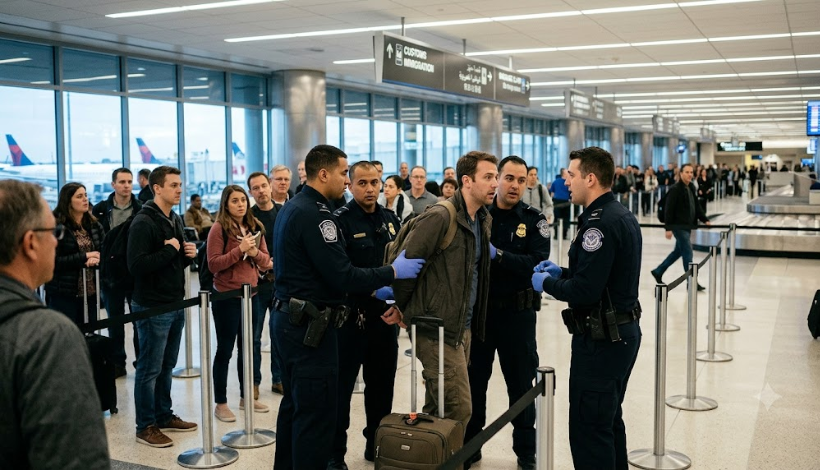
  • Airports in Delhi, Mumbai, Bengaluru and Hyderabad saw long queues at check-in and customer service counters, as travellers tried to rebook, seek refunds or find alternative flights.

  • Several passengers reported reaching the airport only to discover last-minute cancellations or long delays, with limited communication from the airline and long waits for assistance.

  • IndiGo’s On-Time Performance (OTP) crashed dramatically:

    • In November, OTP had already fallen to 67.7 percent, from 84.1 percent in October.

    • On some of the worst-affected days this week, OTP for IndiGo was reported as low as 19.7 percent, as cancellations and long delays dominated operations.

At some airports, parking bays were fully occupied with grounded or delayed aircraft, forcing diversions of flights operated by other airlines as well, spreading the disruption beyond IndiGo’s own network.


What Is DGCA Doing About It?

The Directorate General of Civil Aviation (DGCA) has stepped in to probe the situation and has called IndiGo for explanations.

Key regulatory actions so far:

  • DGCA has summoned IndiGo officials to its headquarters, asking them to present the “facts leading to the current situation” and to share concrete plans to reduce cancellations and delays.

  • The regulator is investigating IndiGo’s flight disruptions, the scale of crew shortage and its compliance with new FDTL norms.

  • DGCA has also analysed the airline’s cancellation data for November, publicly confirming that a large share of disruptions are linked to crew/FDTL and airport/airspace factors, some of which are beyond IndiGo’s direct control but others tied to its planning.

Depending on the findings, DGCA could insist on capacity rationalisation, slot adjustments, and stricter monitoring of schedule declarations, to ensure passengers are not sold tickets for flights that cannot be reliably operated.


IndiGo’s Response: “Calibrated Adjustments” Over The Next 48 Hours

IndiGo has acknowledged the crisis and said it is taking “calibrated adjustments” to stabilise operations.

According to the airline’s statements:

  • IndiGo is temporarily pruning and re-balancing its schedule for the next 48 hours to bring cancellations under control and regain punctuality.

  • The airline has said that the current turbulence is driven by a combination of new crew rostering rules, winter schedule realignment, technical glitches, weather, and congestion, which together had a “compounding impact” that was hard to anticipate in advance.

  • IndiGo has assured that it is working on re-rostering crew, optimising aircraft utilisation, and enhancing communication with passengers to minimise further inconvenience.

However, the full normalisation of operations could take a few days, especially if crew availability and FDTL constraints remain tight.


What Passengers Should Do If Their IndiGo Flight Is Affected

With cancellations and delays still ongoing, passengers booked on IndiGo over the next few days should be prepared and proactive.

Practical steps recommended in this scenario:

  • Check flight status frequently
    Use IndiGo’s official channels or airport flight information displays to track the latest status before leaving for the airport, especially if flying from Delhi, Mumbai, Bengaluru or Hyderabad, which are the worst affected.

  • Look for communication from the airline
    IndiGo is sending SMS, app and email alerts for many cancellations and major delays. Passengers should watch their registered contact details closely and keep PNR handy.

  • Use online rebooking/refund options wherever possible
    Digital rebooking or refund options can be faster than waiting in long airport queues. However, given the scale of cancellations, alternative flights may also be limited or fully booked.

  • Allow extra buffer time
    For critical connections—like international departures or important events—build extra time into plans, as airport processes may be slower due to crowding and staff pressure.

  • Check rights and policies
    Under India’s passenger rights framework, travellers on cancelled or excessively delayed flights may be eligible for refunds or alternative arrangements. DGCA’s intervention increases the likelihood that airlines will be asked to protect impacted passengers as far as feasible.


What This Crisis Reveals About India’s Aviation System

The IndiGo cancellations are not just a one-off operational glitch; they highlight deeper structural stresses in Indian aviation.

  • Aggressive growth vs. resource limits: IndiGo’s network and market share have expanded rapidly, but pilot supply, grounded aircraft due to engine issues, and new safety-driven duty norms have squeezed operating margins and buffer capacity.

  • Sensitivity to regulatory and safety changes: The sharp disruption triggered by a change in FDTL norms underlines how tightly airlines schedule their fleets and crew, leaving less room to absorb regulatory shocks.

  • Passenger vulnerability to systemic disruptions: A problem at a single dominant carrier like IndiGo can ripple across the system, as seen by the impact on airport capacity, other airlines’ slots, and overall congestion.

The unfolding situation is a stress test for both IndiGo’s planning and India’s regulatory oversight mechanisms.


Outlook: When Will IndiGo Operations Normalise?

IndiGo has signaled that the next 48 hours are critical as it recalibrates schedules and rosters to restore stability.

In the near term:

  • Cancellations and delays are likely to continue, though at hopefully reducing levels, as the airline trims its schedule to match available crew and aircraft.

  • DGCA’s scrutiny will likely push the airline to prioritise reliability over sheer frequency, at least temporarily.

  • Passengers flying through Delhi, Mumbai, Bengaluru and Hyderabad should stay alert for changes until normal OTP and cancellation levels are restored.

In the longer term, IndiGo may need to strengthen pilot recruitment and training pipelines, add operational buffers, and refine roster planning to operate sustainably under the new fatigue-management rules.

For now, the advice is clear: if you are booked on an IndiGo flight in the coming days, treat every plan as dynamic—double-check your status, consider alternatives, and allow extra time until the country’s largest airline rides out this bout of turbulence.

Like
Liked
Share Share
Comments ({{commentLength}})
  • {{cmnt.userId.substring(0,1)}} {{cmnt.userId}}

    {{cmnt.comment}}

Location Icon From
  • Flight

    {{fra.City}}

    {{fra.AirportName}}

    {{fra.Country}}
Location Icon To
  • Flight

    {{to.City}}

    {{to.AirportName}}

    {{to.Country}}

Calender Icon Departure Date

Travellers Icon Travellers & class
1 Traveler
Search Flights
Location Icon Enter City name
  • Flight

    {{hca.name}}

Calender Icon Check-In

Calender Icon Check-Out

Guests & Room
{{hotelGuest}} Guests {{totalRoom}} Room
Search
Location Icon From
Cities
Location Icon To
Cities

Calender Icon Pickup Date

Pickup Time

Search
Location Icon Source City
Location Icon Destination City
Departure Date
Search
Location Icon Source City
Location Icon Destination City
Departure Date
Search
Location Icon Destination Name
  • {{ct.city}}

Search