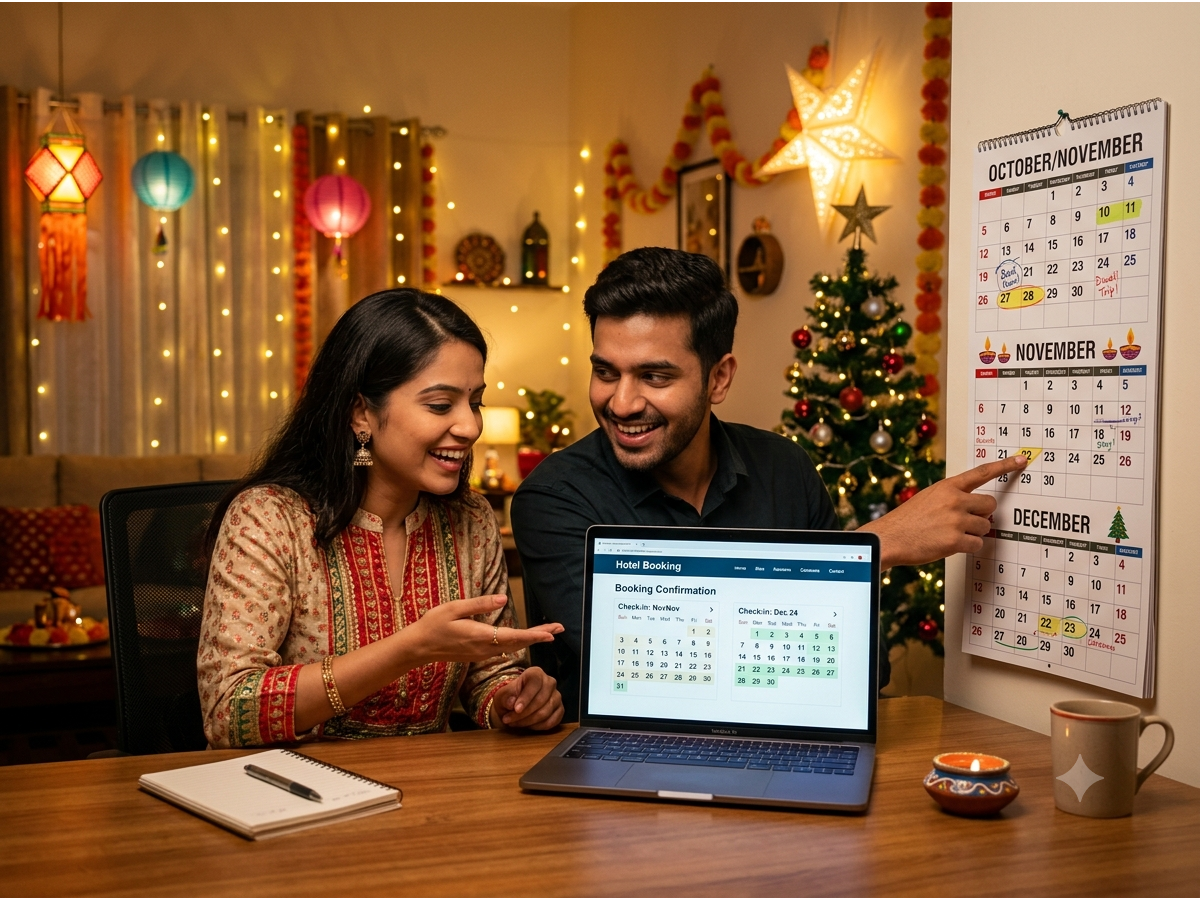
Book Diwali and Christmas hotels 8–12 weeks in advance to secure better rates and your preferred property before festive demand drives prices up and availability down. For Diwali 2026 (8 November), aim for August–September, especially for Rajasthan, Varanasi, Amritsar, and hill stations. For Christmas and New Year, book September–October, with Goa’s popular beachfront and boutique properties often requiring even earlier planning. If plans are uncertain, a refundable early booking can protect both availability and flexibility.
The answer most people discover the hard way is earlier than you think. The hotel that was available and affordable in September is the hotel that is unavailable in October or priced at twice the rate when the Diwali week arrives. The beachfront property in Goa that looked promising in November is sold out for Christmas week by the time December searches begin. Hotel booking for Diwali and Christmas is not like booking for an ordinary weekend; these are the two most concentrated domestic travel demand periods in the Indian calendar, and the properties that make the best trips happen are finite resources that fill on a first-confirmed basis.
This guide covers when to book, why the pricing behaves the way it does, and what specific decisions about timing, property type, and cancellation terms change the outcome. For broader seasonal planning, travellers can also refer to this winter travel planning guide for December trips for destination ideas, booking considerations, and practical preparation tips.
Why Festive Hotel Booking Works Differently
Standard hotel booking advice: book two to three weeks ahead, compare prices across platforms, and check for last-minute deals. This applies to travel periods when demand is predictable and distributed. Diwali and Christmas do not behave this way.
Both festivals create a demand concentration rather than a demand elevation. The difference matters: a demand elevation means more travellers than usual are booking across a broad window; a demand concentration means the same number of travellers are all trying to secure accommodation for the same three to seven days simultaneously. The result is that the booking curve steepens earlier and more sharply than for ordinary peak seasons, and the price increases are not gradual; they are stepped, with notable jumps when inventory drops below certain threshold levels.
Hotel booking for Diwali and Christmas at the right time captures the property and the price before either of these steps occurs. Travellers can compare available properties, room options, prices, and stay dates directly through EaseMyTrip hotel booking.
The Diwali Hotel Booking Timeline

When Diwali Falls and Why It Matters
Diwali follows the Hindu lunar calendar and falls on the new moon (Amavasya) of the Kartik month; in 2026 it falls on 8 November. The booking pressure for Diwali travel builds unevenly. Properties in heritage Rajasthan destinations Jaipur, Udaipur, Jodhpur and in the major Diwali spectacle cities Varanasi and Amritsar begin filling for the festival week from late August onwards.
For Diwali hotel deals 2026, the window where a good choice of properties is still available at the lower pricing tier closes around mid-September. From late September, available inventory narrows, and the remaining properties are priced at rates that reflect low availability rather than competitive positioning.
The Best Booking Window for Diwali
The optimal hotel booking for Diwali and Christmas timing for the Diwali period is:
Eight to ten weeks before the festival for popular destinations and heritage properties, this means booking in mid- to late August for a November Diwali. The best-regarded properties at Jaipur's hotel palace circuit, the ghat-facing guesthouses in Varanasi, and the properties in Amritsar near the Golden Temple operate with limited room counts that make them genuinely unavailable rather than merely expensive if the booking is left too late.
Six to eight weeks before the festival for city hotels at major metro destinations Mumbai, Delhi, and Bengaluru. These cities have sufficient hotel inventory so that the pressure is less acute than at pilgrimage and heritage destinations, but the rate premium for Diwali week bookings made inside six weeks is still significant.
The refundable rate calculation: For travellers whose Diwali plans are not yet confirmed in August, booking a refundable rate at the preferred property holds the room while the plans solidify. The cancellation deadline on most refundable rates, typically 48 to 72 hours before check-in, provides a meaningful window to cancel if the trip does not happen. The cost of booking refundable versus non-refundable at eight weeks out is typically modest; the cost of discovering the property is sold out when the trip is confirmed is the unavailability itself. For additional strategies to reduce festive travel costs, see this guide on how to book cheap flights and hotels in December.
The Christmas and New Year Hotel Booking Timeline

The December Peak Is Earlier to Book Than Most People Expect
Christmas and New Year accommodation pressure is, if anything, more acute than Diwali for certain destination categories. Goa, the most popular domestic Christmas destination in India, sees its beachfront and resort properties filling for the 22 December to 2 January window from as early as September. A traveller who searches for Goa accommodation in November for a Christmas week stay is not looking at a competitive market; they are looking at what nobody else wanted.
Christmas hotel booking in India for the top-tier Goa properties, particularly standalone villas, beach-adjacent resorts, and boutique properties in Anjuna, Vagator, and Morjim, requires booking in August or September for guaranteed first-choice availability. By October, the selection has narrowed. By November, the available inventory at the most-desired locations consists primarily of late cancellations and less popular room categories.
New Year Hotel Prices and the Premium Window
New Year hotel prices for 2026 follow a pattern that is worth understanding before the search begins. The 30 and 31 December nights carry the highest premium of the entire festive season properties at beach and hill destinations; these nights are priced at their annual peak, and the rate difference between a 28 December check-in and a 30 December check-in at the same property can be several thousand rupees per night.
Booking the full stay, including the peak nights, at the earlier pricing tier, securing the 28 to 2 January stretch at a time when the per-night rate has not yet reflected the New Year premium, is the most effective way to manage New Year hotel prices in 2026. Properties price their inventory dynamically, and the same room night that costs INR 5,000 in a September booking may be priced at INR 9,000 or INR 12,000 by November when the New Year nights are priced at the premium tier.
Destination-Specific Booking Timelines
Goa
Christmas hotel bookings in India for Goa need September action for the best properties. The Christmas–New Year window in Goa operates as a micro-season within the season rates and availability for the 22 December to 2 January stretch; they are governed by dynamics that are entirely separate from the October and February shoulder season rates at the same properties. Eight weeks before 22 December is mid-October at the latest; ten to twelve weeks is mid-September.
Rajasthan (Jaipur, Udaipur, Jaisalmer)
Diwali in Rajasthan is a visual event: the city palaces illuminated, the markets lit, and the festival atmosphere amplified by heritage architecture. Heritage hotel properties here, palace conversions with limited room counts, have among the tightest booking windows of any festival destination in India. For Diwali hotel deals in 2026 in Rajasthan, August booking is not early; it is appropriate.
Jaisalmer's desert camps, which form the primary accommodation offer at the Thar Desert experience, operate a similar tight-capacity model and fill for the Diwali and winter tourist season beginning in October. Booking in August or September for a Diwali week Jaisalmer stay addresses this constraint.
Hill Stations (Shimla, Manali, Ooty, Munnar)
Hill station hotels at all major domestic destinations see compressed booking pressure around Diwali and Christmas for a specific reason: capacity is structurally limited by the mountain geography, and the better properties have room counts in the dozens rather than the hundreds. A Shimla or Manali property with 20 rooms that receives enquiries from 200 families in the same week does not have a pricing solution; it has an availability problem. Booking six to eight weeks before Diwali and eight to ten weeks before Christmas covers the hill station category adequately. For destinations that are more convenient to reach by train, travellers can check and book train journeys through EaseMyTrip Railways while planning their hotel dates.
The Festive Hotel Early Bird Calculation
The festive hotel early bird booking decision is ultimately a calculation between two risks: the risk of booking a trip that does not happen (if plans change after a non-refundable booking) and the risk of not booking and finding the preferred property unavailable or unaffordable when the trip is confirmed.
The calculation favours early booking for most families and travellers because:
- Non-refundable rates booked early are typically lower than refundable rates booked late; the pricing differential partially offsets the non-cancellation risk.
- Refundable rates at good properties, booked early, hold the option without committing the full cost; the cancellation can happen at minimal or no penalty if plans change.
- The alternative to early booking or late booking at whatever remains available carries both a higher cost and a lower quality of choice that is impossible to reverse once the inventory has moved.
How EaseMyTrip Makes Festive Hotel Booking More Manageable
Hotel booking for Diwali and Christmas involves monitoring availability across multiple destinations simultaneously, comparing non-refundable and refundable rate differentials, and understanding when the inventory at a specific property is thinning to the point where booking becomes urgent. EaseMyTrip's AI-powered availability alerts monitor saved properties and routes and notify travellers when availability drops or when rates move, which is the mechanism that converts the general advice to "book early" into a specific, actionable prompt at the right moment.
The platform's festive hotel early bird pricing tools display the rate differential between booking now and booking at various future points for saved properties, making the cost of waiting visible rather than theoretical. As AI continues to improve how booking platforms anticipate demand concentration for specific festival dates and surface the properties most likely to sell out before they actually do, EaseMyTrip is building towards a platform that manages the festive hotel booking window proactively, alerting travellers before the inventory crisis rather than during it. For the two most concentrated demand periods in the Indian travel calendar, that kind of forward-looking, AI-driven booking intelligence is what separates a well-planned festive trip from one that settles for whatever is left.
FAQs
Q: How early should hotel bookings for Diwali and Christmas be done?
Hotel bookings for Diwali and Christmas at popular destinations like Goa, Rajasthan heritage hotels, and hill stations should be done eight to twelve weeks before the festival dates. For Diwali 2026 (8 November), this means booking in August or September. For Christmas week, this means booking in September or October. City hotels at major metros have more inventory and allow slightly later booking, six to eight weeks, but still carry a rate premium for bookings made inside this window.
Q: Are there genuine Diwali hotel deals in 2026, or are festive rates always elevated?
Diwali hotel deals 2026 for those properties booked in advance, eight to ten weeks before the festival, are priced higher than their off-peak counterparts, but not at the premium of late booking. The deals are not the aggressive discounting of low-season periods; they are competitive rates at preferred properties that are still available before demand concentration drives them into peak pricing. Booking in August for a November Diwali captures the best available rates within the festive category.
Q: How do Christmas hotel booking prices in India differ from regular travel periods?
Christmas hotel bookings in India, particularly for Goa, hill stations, and beach destinations, command a premium that reflects the concentrated demand of the 22 December to 2 January window. The premium is most acute for the 30 and 31 December nights, which are priced at annual peak rates at most resort and beach properties. Properties booked in September or October for the full Christmas–New Year stretch capture rates that represent the early-booking tier; the same properties and nights booked in November or December are priced at whatever their dynamic pricing algorithm produces in response to near-full inventory.
Q: What is a festive hotel early bird booking, and is it worth it?
A festive hotel early bird booking is a reservation made significantly before the festival date, typically eight to twelve weeks in advance, at a rate that is lower than what the same property will charge as the date approaches and inventory tightens. It is worth it for destinations with limited room counts where the preferred property will genuinely be unavailable at any price if the booking is left too late, and for destinations where the rate differential between an early non-refundable booking and a late refundable one is large enough to offset the non-cancellation risk. Booking a refundable rate early provides the early-bird availability benefit without fully committing to a non-flexible booking.
Q: How can EaseMyTrip help with Diwali and Christmas hotel booking?
EaseMyTrip’s AI-based availability alerts notify the travellers about low inventory at saved properties or rising rates, giving a clear cue to book when availability status changes instead of keeping a manual watch. The platform’s rate comparison tools show the variation between current rates and those in the past for the same property and dates, explaining the cost of waiting. For hotel booking for Diwali and Christmas planning in particular, the platform’s holiday period filters highlight properties with availability for the peak festival nights with cancellation policy information, helping travellers to make the early booking decision with complete pricing and flexibility details.






 Last Updated: 22 September 2026

 Share
 Download as PDF
 From

 Departure Date
 Travellers & class

 Rent For
 Departure Date






 Share








{{cmnt.comment}}