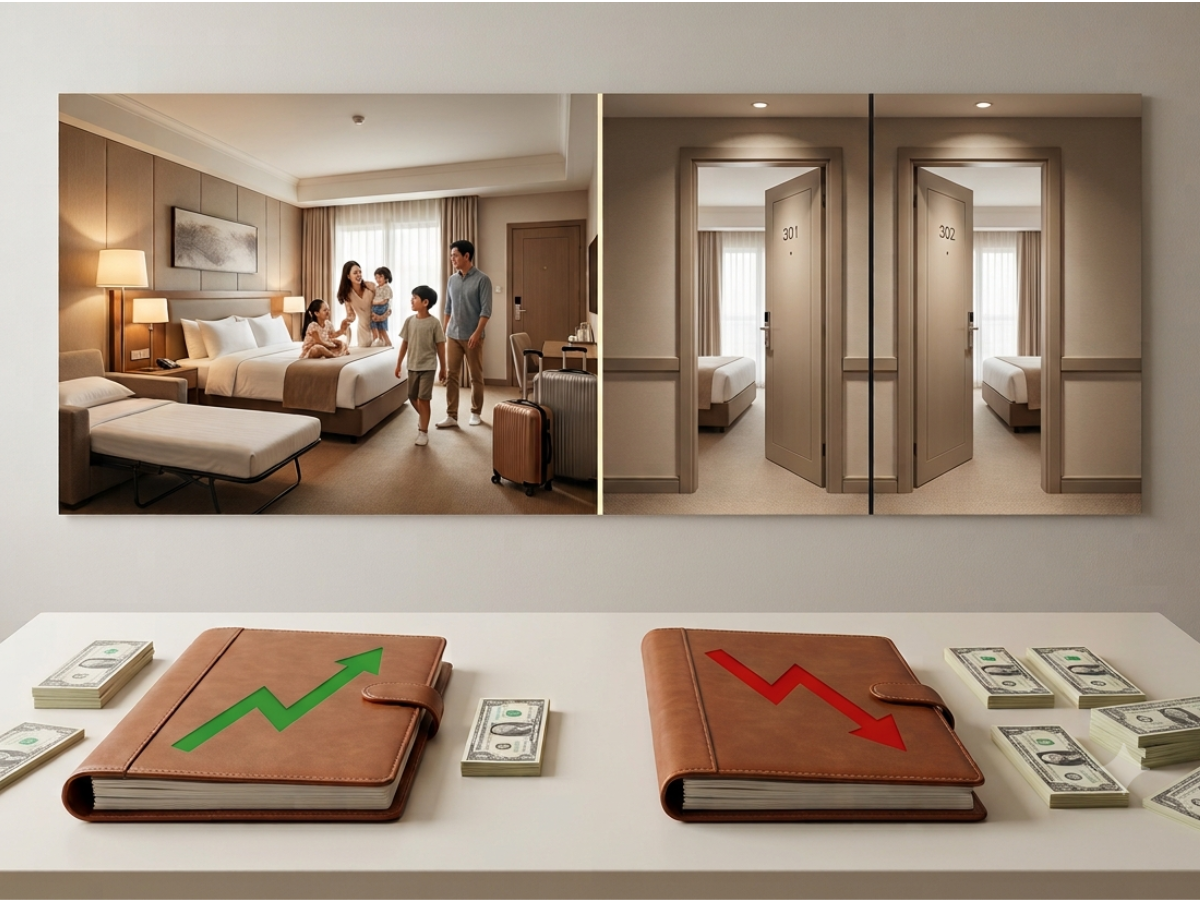
One family room is not always cheaper than two separate hotel rooms—the lower-cost option depends on the hotel, travel dates, room category, group size, occupancy rules, and what is included in the rate. Compare the total after taxes and fees, check whether the family room actually accommodates everyone, and factor in breakfast and other inclusions. Two standard or connecting rooms can cost less and offer more privacy, while family rooms or suites may provide better value when priced competitively or when they include extra space and amenities. For longer stays, a family suite can justify its higher price through separate living or sleeping areas and a kitchenette. The most reliable approach is to compare both configurations for the exact property and dates before booking.
It is one of those hotel booking decisions that looks straightforward until the search results come back and the numbers do not behave the way expected. A family of four looks at a family room listed at INR 6,500 and two standard double rooms listed at INR 3,200 each, and suddenly the supposedly simpler option is the more expensive one. Or the reverse: the family room appears cheaper but fits only two adults and two children under twelve, and the third adult in the group makes the whole calculation redundant.
The family room vs two-room hotel cost question does not have a universal answer. It has a context-dependent one, and the context is determined by the composition of the travelling group, the specific hotel's room category pricing, and the destination. Getting this right before confirming a booking saves money; getting it wrong saves time but costs more.
Why the Family Room vs Two Rooms Question Matters More Than It Seems
Most families booking accommodation for a trip focus on the headline per-night rate and stop there. The family room vs two rooms hotel cost calculation is worth doing specifically because the answer varies by hotel in ways that are not predictable from the outside.
Some hotels price their family rooms at a premium over two standard rooms because the family room category includes amenities a sitting area, a kitchenette, and a larger bathroom that the standard rooms do not. Others price family rooms as a single-unit booking that is cheaper than two separate bookings because occupying one room rather than two reduces the hotel's per-booking operational cost. And some hotels price them identically, in which case the family room is the obvious choice for the privacy it provides without the coordination overhead.
Knowing which category a specific hotel falls into requires running the comparison rather than assuming and doing it at the point of search rather than at the point of booking. Travellers can also use these travel hacks to save money when comparing accommodation and other trip expenses.
When Two Separate Rooms Are Cheaper
The family room vs two rooms hotel cost comparison favours two separate rooms most often in the following situations:
- Budget and mid-range hotels with limited room categories. Hotels that have a small number of room types often price their largest category at a significant premium over their standard rooms. A hotel with only standard doubles and a premium family suite may charge ?4,000 for a standard double and ?9,500 for the suite of two doubles at ?8,000 total, which is meaningfully cheaper than the suite.
- High-demand periods when family rooms are already at peak pricing. Dynamic pricing affects room categories independently. A family room that is the last one available in a hotel may be priced at its highest tier, while standard rooms still have inventory at a lower tier. Running the comparison on the specific dates rather than assuming the family room will always be the cheaper option accounts for this.
- Groups with multiple adults. A budget hotel for family travel that includes three or four adults alongside children may find that two standard rooms, each comfortably sleeping two adults, are more practical and more comfortable than a family room designed for two adults and two children, which would be overcrowded at three adults and two children regardless of price.
When Family Rooms Are Cheaper

The calculation swings the other way in several consistent scenarios:
- Larger hotels and resort properties with proper family room categories. Properties that specifically cater to families, beach resorts, and hill station hotels with family-orientated infrastructure often price their family rooms more competitively because the category is a volume driver for them. A family room at a resort that prices it as slightly above a single standard room rather than as two standard rooms is clearly the better value.
- Properties that charge per room rather than per person. When a hotel's pricing model is room-based rather than occupancy-based, a family room that sleeps four at a single room rate is genuinely cheaper than two standard rooms at the same single room rate each.
- All-inclusive properties. At hotels where meals, activities, and amenities are bundled into the room rate, a single family room booking bundles everyone into one cost centre. Two separate rooms at the same property would multiply the per-room component of the all-inclusive fee regardless of the room rate comparison.
Connecting Rooms: The Option Most Families Do Not Check
Connecting rooms in the hotel with adjacent rooms with an internal door between them that can be locked or opened represents a third option that is worth requesting or searching for specifically. Connecting rooms provide the privacy of separate rooms with the accessibility of a family room, which suits families with teenagers or groups of adults who want independent space but easy communication.
The practical issue is that connecting rooms in the hotel are not always bookable as a category in online search results; many booking platforms list rooms individually without indicating which ones are adjacent. For additional ways to reduce the overall cost of a family trip, these 15 travel hacks used by pro travellers can help families plan more efficiently. Calling the hotel directly and requesting connecting rooms as a condition of booking is the reliable approach. Some hotels will accommodate this request without charge; others may treat connected rooms as a premium configuration.
For multi-generational family travel, grandparents, parents, and children, the connecting room format often provides the best balance of proximity and independence, and the combined cost of two connecting standard rooms is frequently lower than a single family suite at the same property.
The Family Suite: When It Justifies the Price
The family suite hotel booking category sits above the standard family room in most hotels' room hierarchy. A suite typically adds a separate living area, sometimes a kitchenette, a larger bathroom with additional fittings, and in some cases a second bedroom, the last of these being the configuration that most meaningfully changes the family accommodation experience.
A family suite hotel booking with a separate bedroom for children justifies its premium most clearly on longer stays of four or more nights, where the lack of a separate sleeping area in a standard family room becomes a genuine comfort issue rather than a minor inconvenience. On a one- or two-night stay at a transit hotel, the suite premium is harder to justify.
The kitchenette in a suite becomes valuable on stays where the group wants to prepare some meals independently, a significant cost consideration for long stays at destinations where restaurant prices are high, or for families with young children whose meal timing does not align with restaurant service. Families planning an international trip can also explore this guide to travelling Europe on a budget for practical ways to manage accommodation and daily travel costs.
Hotel Room Sharing Tips: Making Two Rooms Work Efficiently
When two separate rooms are the chosen or cheaper option, hotel room sharing tips that make the arrangement practical rather than logistically fragmented:
- Book rooms on the same floor and request adjacent allocation. Most hotels can accommodate a same-floor, adjacent room request if made at the time of booking or confirmed at check-in. This makes moving between rooms during the evening for bedtime routines for sharing food far less disruptive than two rooms on different floors.
- Request a communicating door at the time of booking. Even if the hotel's online system does not list connecting rooms as a category, a direct request at booking or check-in may be accommodated depending on availability.
- Use the larger room for group activities. If the two rooms are of different sizes, one double and one twin, for example, designating the larger one as the gathering space for meals, card games, or pre-dinner drinks and the smaller one as the sleep-only space for children, the two-room arrangement feels more coherent than two equally used separate spaces. Travellers looking to stretch their accommodation and daily travel budget further can also explore these 10 genius ways to travel the world for under $50 a day.
Running the Comparison: What to Check Before Booking
The family room vs two rooms hotel cost comparison that produces the correct answer for a specific booking involves:
- Checking the family room rate, including all taxes and fees, against the two-room total, including all taxes and fees, the fee structure can differ between room categories at the same hotel, which makes pre-tax comparisons misleading.
- Checking the occupancy limit of the family room against the actual group composition. A family room listed as sleeping four may have a one-adult-and-three-children or two-adults-and-two-children occupancy restriction that does not match a group of three adults and two children.
Checking whether breakfast is included per person or per room. A family room with breakfast for four at a per-person rate may price out differently from two rooms with breakfast for two per room at the same per-person rate, and some hotels include breakfast in family room packages but not in standard room bookings. For families travelling domestically, this guide on how to travel India on a INR 5,000 budget offers additional ideas for keeping the overall trip cost under control.
How EaseMyTrip Makes Family Hotel Booking Clearer
The family room vs two rooms hotel cost comparison is exactly the kind of multi-variable calculation that benefits from a booking platform that surfaces the information needed to make it accurately rather than requiring the traveller to open multiple search windows and run the numbers manually. Families can also compare bundled flight and hotel packages when looking for ways to manage accommodation and airfare costs together.
EaseMyTrip's hotel search allows filtering by occupancy and room type simultaneously, displaying family room options alongside standard room combinations for the same property so the comparison is visible before the decision is made. If the family trip also involves air travel, travellers can book flights on EaseMyTrip and compare available options for their route and dates. The platform's AI-powered recommendation tools surface budget hotels for family options that have been reviewed specifically by families with similar group compositions, which is more relevant information for a four-person family than a general star rating.
For connecting rooms in the hotel, requests which typically require direct communication with the property, EaseMyTrip's booking interface includes a special request field that routes the connecting room preference to the hotel at the time of booking confirmation, reducing the chance that the request is missed or processed too late. As AI continues to improve how booking platforms understand the specific needs of family travel, occupancy requirements, room adjacency, and meal inclusion preferences. EaseMyTrip is building towards a system that surfaces the right family accommodation configuration for each group's specific composition rather than returning an undifferentiated list sorted by price alone. For a decision where the right answer depends on details that a headline rate does not reveal, that kind of specific, group-aware recommendation is what makes the booking process genuinely useful.
FAQs
Q: Is a family room always cheaper than booking two separate hotel rooms?
The family room vs two-room hotel cost comparison does not have a universal answer. Family rooms are sometimes cheaper than two standard rooms, sometimes more expensive, and sometimes identically priced. The outcome depends on the specific hotel's pricing model, the available inventory on the travel dates, and the occupancy composition of the travelling group. Running the comparison on the specific property and dates before booking is more reliable than assuming either option will always be cheaper.
Q: What is the difference between a family room and a family suite hotel booking?
A family suite hotel booking typically includes a separate living area and sometimes a second bedroom, in addition to the standard sleeping area. A family room is generally a single sleeping space configured for a family with two double beds or one king and one bunk, for example, without the separate living or sleeping areas of a suite. The suite configuration is most valuable on longer stays where the absence of a separate space becomes a comfort issue and on bookings that include a kitchenette for self-catering.
Q: What are connecting rooms in a hotel, and how do families book them?
Connecting rooms in the hotel are adjacent rooms with an internal door between them that can be locked or opened, providing the privacy of separate rooms with the accessibility of a shared space. They are not always bookable through standard online search requesting connecting rooms directly with the hotel at the time of booking, or at check-in is the most reliable approach. Many hotels accommodate this request without additional charge depending on availability; some treat it as a premium configuration.
Q: What are the best hotel room-sharing tips for families in two separate rooms?
The most practical hotel room sharing tips for families in two separate rooms are to request same-floor adjacent rooms at the time of booking, ask whether the hotel has connecting rooms that can be allocated, designate the larger room as the group gathering space and the smaller as the sleep-only space for children, and confirm breakfast inclusion and occupancy limits on both rooms before finalising the booking. These steps make two separate rooms function as a coherent family accommodation rather than two isolated spaces.
Q: How can EaseMyTrip help find the best budget hotel for family travel?
EaseMyTrip's platform allows filtering by occupancy and room type simultaneously, making the family room vs two rooms hotel cost comparison visible for the same property before the booking decision is made. The platform's AI-powered tools surface budget hotels for family options reviewed specifically by similar family compositions, provide occupancy limit information at the search stage rather than only at checkout, and route special requests, including connecting room preferences, to the hotel at booking confirmation. For families whose accommodation needs are more specific than a star rating captures, this kind of group-aware search and recommendation is what makes the platform practically useful.





 Last Updated: 18 September 2026

 Share
 Download as PDF
 From

 Departure Date
 Travellers & class

 Rent For
 Departure Date






 Share









{{cmnt.comment}}