Diwali flight ticket prices are generally lowest when booked three to four months in advance, while the six-to-eight-week window offers a strong balance between competitive fares and seat availability. Prices typically rise sharply during the final two weeks before Diwali as demand increases and seats become limited. Travellers can save further by choosing flexible travel dates, comparing fares across nearby dates, monitoring route-specific price trends, and using fare alerts to catch price drops.
Every year, the same conversation happens in offices, family group chats, and travel forums across India in September and October. Someone mentions they need to book flights home for Diwali and discovers that the fares they were hoping for no longer exist or are barely recognisable compared to what was available three weeks earlier. The prices have moved, the seats are filling, and the comfortable window for booking affordable Diwali flight travel has quietly closed.
This guide exists to prevent that conversation. For travellers ready to compare fares and plan their journey, explore EaseMyTrip's Diwali flight booking options to find suitable flights for your travel dates. It covers when Diwali flight booking actually produces the best fares, why the price curve behaves the way it does, and what specific decisions about timing, route, flexibility, and booking platform features determine whether the Diwali journey costs a reasonable amount or a punishing one.
Why Diwali Flights Are Expensive and When They Are Not
Diwali flight prices follow a demand curve that is both predictable and steep. The festival creates a travel surge that Indian aviation infrastructure absorbs imperfectly. There are a finite number of seats on a finite number of aircraft on the routes people most want to fly, and as demand concentrates into a narrow window, the dynamic pricing algorithms that all major airlines use push fares upward in proportion to how quickly seats are filling.
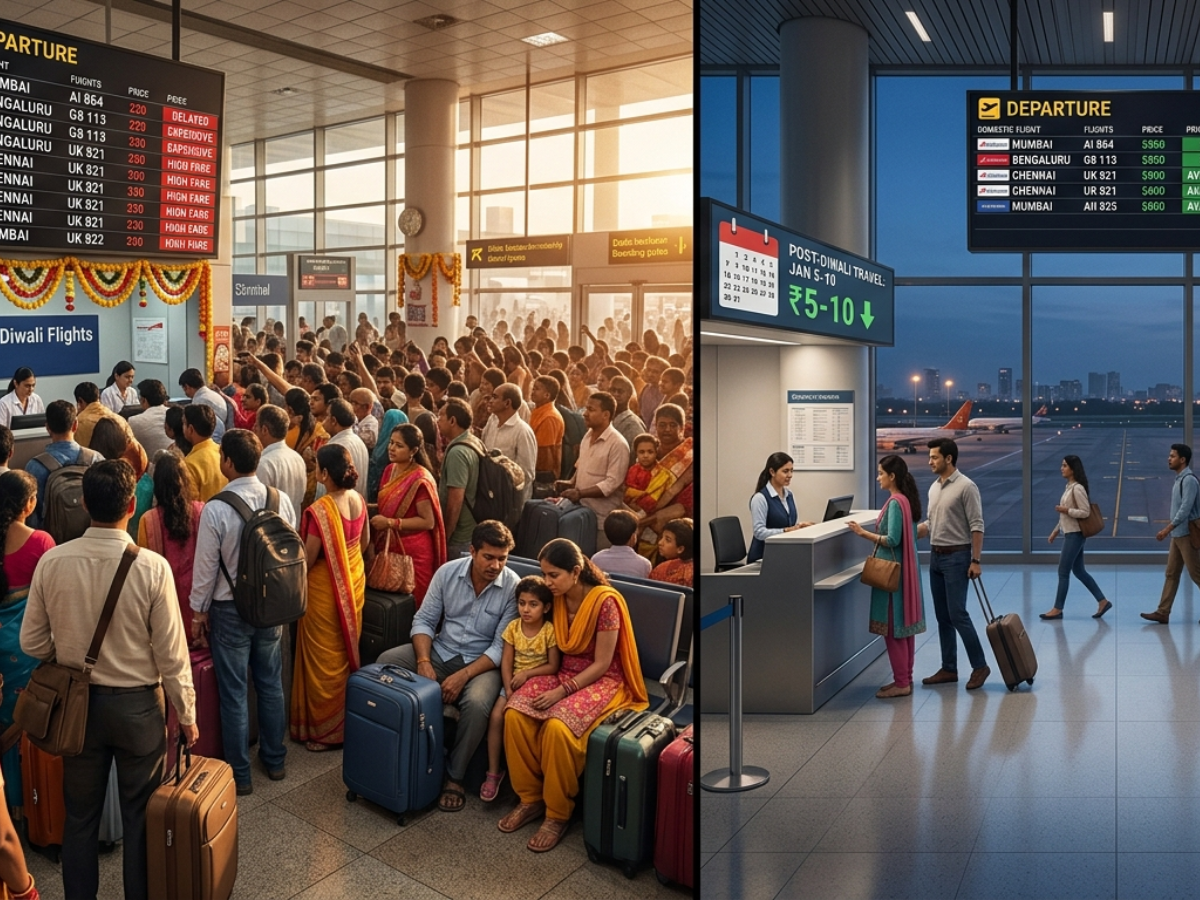
The mechanics of this are straightforward. When a flight has 80 per cent of its seats filled, the remaining 20 per cent are priced at a premium that reflects both the scarcity of seats and the willingness of late-booking travellers to pay more rather than not travel. When a flight has only 40 per cent of seats filled, the airline's pricing algorithm is still offering competitive fares to drive booking velocity. The Diwali window compresses this entire dynamic into a shorter calendar period than most domestic travel occasions, which is why the price difference between booking six weeks out and booking two weeks out for the same Diwali flight can be several thousand rupees on a single ticket.
The Diwali Flight Booking Timeline: When to Book
The Optimal Window: Six to Eight Weeks Before the Festival
The consistent pattern across multiple years of Diwali flight booking data is that the six- to eight-week window before the festival, typically mid-September for an October Diwali, offers the best combination of seat availability and competitive fare. Airlines have published their Diwali schedules by this point, the inventory is available to book, and demand has not yet reached the concentration that drives prices into the premium tier.
At six to eight weeks out, a traveller booking the Mumbai–Delhi or Bengaluru–Hyderabad sector for a Diwali departure will see fares that are elevated compared to an off-peak Monday in March but significantly lower than what the same sectors will show two weeks before the festival. This is the best time to book Diwali flights for most routes and most travel situations. Beyond booking at the right time, using the right search and booking strategies can also help reduce your overall airfare, so these tips for getting cheap flight tickets can help travellers make better booking decisions.
The Secondary Window: Three Months and Beyond
Airlines release their Diwali inventory into booking systems as soon as the festival dates are confirmed, typically three to four months ahead of the festival. Travellers who book in this early window, before demand begins to build in earnest, can access the lowest available fares in the entire booking cycle. The same principle of timing applies beyond Diwali travel, and understanding the best time to book flights can help travellers plan other trips around periods when fares are more favourable. These fares are not the standard promotional fares that airlines run for off-peak travel, but they reflect a pricing tier that the algorithm has not yet pushed upward in response to booking velocity.
Cheap Diwali flights, in the most literal sense, the lowest fares available for the highest-demand travel dates, exist primarily in this three-to-four-month advance window. The constraint is that these fares typically come with change and cancellation fees that a traveller booking this far in advance should factor into the total cost calculation.
The Window to Avoid: Two Weeks and Under
Diwali flight prices in the two weeks immediately before the festival are the highest of the entire booking cycle on most routes. The combination of high demand, low remaining inventory, and the late-booker premium that airline algorithms apply to nearly-full flights produces fares that can be two to four times the equivalent of off-peak route price.
The Tatkal logic that applies to railway bookings is a defined premium over base fare that does not apply to domestic aviation, where dynamic pricing produces outcomes that are less predictable and often more extreme. Booking in the two-week pre-Diwali window is not necessarily avoidable for everyone; work schedules, last-minute family plans, and emergencies all create late bookings, but for planned travel, this window should be treated as the one to avoid. When comparing fares, it is also worth considering where to buy cheap flights so that the booking channel itself does not become an overlooked part of the cost calculation. If circumstances force you to book close to Diwali, these last-minute flight booking tricks can help you approach a late booking more strategically.
Route-Specific Patterns for Diwali Flights
Not all Diwali flight booking routes behave identically. The fare curve is steeper on routes with fewer daily flights and lower total seat counts. A route with two or three daily services sees prices rise faster than a route with twelve daily services as the seats fill.
Routes with the sharpest Diwali fare curves:
Delhi–Patna and Delhi–Lucknow see some of the most extreme Diwali fare movements of any domestic sector. The home-bound travel demand from UP and Bihar residents working in Delhi concentrates intensely around the Diwali window, and the limited daily flights on these sectors cannot absorb it without significant fare increases. Booking eight weeks ahead on these routes is a minimum rather than a suggestion.
Mumbai–Goa and Bengaluru–Goa see Diwali fare increases driven by leisure travel rather than homeward journeys, and the pattern is slightly different; the fare peak is on the outward Diwali-week departure rather than the festival day itself. Booking the outward leg first on these routes, before the leisure demand concentrates, is the specific priority.
Metro-to-metro routes Delhi–Mumbai, Delhi–Bengaluru, and Mumbai–Hyderabad have higher total daily seat counts that moderate the fare curve somewhat. These routes still see Diwali premiums, but the premium is less extreme than on thinner routes, and the booking flexibility is correspondingly higher.
Flexibility as a Fare Management Tool
The difference between a fixed Diwali departure date and a flexible window of two to three days either side of the festival can be thousands of rupees on the same route. Cheap Diwali flights most often exist on dates that are adjacent to the festival rather than on the day itself.
The day before Diwali and the day after are consistently cheaper on most routes than the festival day. Departing for home two days before the festival and returning two days after rather than on the day of or immediately after distributes travel across the surrounding days when demand is lower and fares reflect that. Date flexibility is only one part of reducing travel costs; travellers can also use these travel booking hacks to improve their chances of finding better-value fares.
Diwali flight booking with date flexibility requires knowing the festival date accurately each year. Diwali falls on the new moon (Amavasya) of the Kartik month, typically in October or November, and the date shifts annually. Confirming the exact date before searching and then searching the three days before and after the festival date is a more efficient approach than searching only the festival day.
Fare Alerts: The Tool That Does the Monitoring
The most consistent Diwali flight booking advice that experienced travellers offer is to set fare alerts rather than checking fares manually. Manually checking a route once or twice a week produces a lagged view of the fare curve; the traveller sees what was available, not what is available now, and misses the promotional windows that airlines briefly open on specific routes.
Fare alert tools notify the traveller when the price on a saved route drops below a set threshold, which means the monitoring is continuous rather than periodic. For Diwali flight prices that can move by hundreds of rupees within a single day, continuous monitoring produces meaningfully better booking outcomes than weekly manual checks.
How EaseMyTrip Makes Diwali Booking More Manageable
Diwali flight booking through EaseMyTrip's platform provides access to fare calendar tools. Travellers can search and book flights on EaseMyTrip while comparing available fares and suitable travel dates for their Diwali journey. that display the cheapest available fares across a full month's date range in a single view, which makes the date flexibility analysis immediate rather than requiring the traveller to check each date separately. The fare calendar shows which dates have the lowest fares around the Diwali window, allowing travellers to see immediately whether departing two days early saves significantly against the festival day fare.
EaseMyTrip's AI-powered fare alert system monitors saved routes continuously and notifies travellers when fares drop or when a promotional window opens, removing the manual checking burden that makes early booking feel more effortful than it should. For the best time to book Diwali flights, decisions that require monitoring over a period of weeks rather than a one-time search, this kind of automated, AI-driven fare surveillance is what separates a well-timed booking from a lucky one.
As AI continues to improve how booking platforms anticipate demand patterns, including the specific fare curve behaviour of Diwali on a route-by-route basis, EaseMyTrip is building towards a platform that advises on the optimal booking moment for each specific route rather than offering generic guidance about booking early. For a festival where the difference between a well-timed and a poorly timed Diwali flight booking can be thousands of rupees per ticket, that kind of specific, intelligent, route-aware timing advice is what makes the platform genuinely useful rather than merely functional.
FAQs
Q: When is the best time to book Diwali flights for the lowest fares?
The best time to book Diwali flights is six to eight weeks before the festival for the optimal combination of seat availability and competitive pricing. Travellers with confirmed plans three to four months ahead can access the lowest available fares in the full booking cycle, though these typically come with change and cancellation fees. The two-week pre-Diwali window should be avoided where possible; fares in this period are the highest of the entire booking cycle on most routes, reflecting the combination of high demand and low remaining inventory.
Q: Why are Diwali flight prices so high close to the festival?
Diwali flight prices rise sharply in the two weeks before the festival because of the combination of concentrated demand, a large portion of India's travelling population trying to book the same narrow window and low remaining seat inventory. Airline dynamic pricing algorithms push fares upward as seats fill, and the Diwali window compresses the entire demand curve into a shorter period than most domestic travel occasions. The result is that fares in the final two weeks can be two to four times the price available six weeks earlier on the same route.
Q: Are there cheap Diwali flights available, and how can travellers find them?
Cheap Diwali flights, the lowest available fares for festival-period travel, exist primarily in the three-to-four-month advance booking window and in the two-to-three-day adjacent dates around the festival itself rather than on the day. Fare calendar tools on platforms like EaseMyTrip display the cheapest dates across a full month in a single view, allowing travellers to identify immediately whether flying two days before or after the festival saves meaningfully. Fare alerts set on specific routes provide continuous monitoring that catches promotional windows when airlines briefly reduce fares.
Q: Which Diwali flight routes see the sharpest fare increases?
Diwali flight booking on routes with limited daily services Delhi to Patna, Delhi to Lucknow, and similar home-bound corridors from major metros to smaller cities see the sharpest fare increases because the total seat count is lower and the demand concentration is equally high. Metro-to-metro routes with high daily frequency see Diwali premiums but at a lower magnitude. Booking eight weeks ahead on thin-route sectors is a minimum rather than an aspiration; the fare curve on these routes steepens earlier than on high-frequency metro services.
Q: How does EaseMyTrip help with Diwali flight booking?
EaseMyTrip's fare calendar displays the cheapest available Diwali flight fares across a full month's date range in a single view, making the date flexibility analysis immediate. AI-powered fare alerts monitor saved routes continuously and notify travellers when prices drop below a set threshold or when a promotional window opens, removing the manual checking effort that makes early booking feel more difficult than it should. For Diwali flight prices that can move significantly within a single day, continuous automated monitoring through EaseMyTrip's alert system produces better booking outcomes than periodic manual searches.





 September 7, 2026

 Share
 Download as PDF
 From

 Departure Date
 Travellers & class

 Rent For
 Departure Date










 Share








{{cmnt.comment}}